




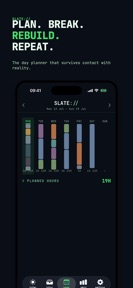





SLATE is a local-first AI daily planner for iPhone and iPad that builds schedules around fixed calendar events.
The App DNA
What makes this app unique?
It removes the cognitive and privacy friction of account-based planning tools by keeping all user data on the device.
For Productivity-focused individuals who prefer local-only data management and require AI assistance to organize daily tasks around fixed calendar events.
What does it look like?
Key features
Automatically adjusts remaining daily schedule when events run long or plans change.
All user data resides on the device with no account or sign-up required.
Parses typed or spoken inputs into structured tasks.
How much does it cost?
The $1.99 upfront purchase model targets users who prioritize data privacy and one-time payments over recurring subscription costs.
Velocity
Maintenance developmentperformanceopaqueShow more...
AI Daily Planner : SLATE maintains a maintenance-level cadence, with only one release recorded in the analyzed window. The latest update focuses exclusively on general stability and performance optimizations rather than new features. Development appears to be in a low-activity state, with no evidence of new content or feature expansion. The publisher currently utilizes opaque release notes, providing no insight into specific technical or functional changes.
Who built it?
Aneesh Pradeep
13+ apps tracked · Productivity
 Employee Evaluation Manager AI
 人生清单与目标 : KICK
 Terminal File Manager Advanced
 AI Mission Alarm Clock : ROUSE
 CAIRN·私密AI日记 心情手账
 Run of Show Planner : CUE
 Damage: Eating Out Tracker
 Grocery Price Tracker: Aisle
 Boat Maintenance Log : KEEL
 AI Thumbnail Maker HOOK PRO
 AI Voice Notes Recorder : GIST
 METAR & TAF Weather : CEILING
User Sentiment
What do users think recently?
How are ratings & reviews evolving?
Not enough recent reviews to extract reliable themes yet.
Read the full review analysisCompetition
Competitive landscape for AI Daily Planner : SLATE
How's the Productivity market?
SLATE occupies a privacy-focused niche in the Productivity category, charging a $1.99 upfront fee. The lack of cloud-sync distinguishes it from the broader market of subscription-based, cross-platform calendar tools.
Read the market outlookThe rivals identified
Unlock the deeper market read.
Access the full report for freeThe Analyst's Read
Key takeaways for AI Daily Planner : SLATE
Where is it heading?
The productivity market is shifting toward cross-device synchronization, leaving SLATE's local-only model increasingly isolated. If SLATE does not introduce a manual data-portability layer, it will struggle to retain users who rely on multi-device planning workflows.
- The maintenance-only release cadence suggests a stable, feature-complete product rather than an active growth phase.
- The absence of cloud-sync creates a long-term retention risk as users switch devices and lose their historical planning data.
The SWOT
- Local-first storage architecture removes privacy-related switching costs
- Manual JSON-based sync would solve multi-device friction
Next best moves
Ship manual JSON-based sync because users lack a backup mechanism for local data → increase long-term retention
The counter-intuitive read
The lack of cloud-sync is not a technical…
Read the full takeSince the last report: The analysis of SLATE has shifted from viewing local-only storage as a purely positive privacy feature to identifying it as a significant retention risk due to the lack of multi-device synchronization.
Bottom line
SLATE defends a niche for privacy-conscious users, but the absence of cloud-sync limits its utility for multi-device workflows. A manual export-import sync mechanism would unlock retention for power users without requiring a server-side infrastructure investment.
Unlock 1 critical friction, 1 market threat and the analyst’s take.
Access the full report for freeFAQ
Does SLATE sync my data across my iPhone and iPad?
Do I need an account to use SLATE?
Is there a free version of SLATE?
Sources
- [1] App Store, source
Report last updated