



ASL American Sign Language is a free educational app for iOS and Android that teaches finger spelling and basic signs through flashcards and matching games.
The App DNA
What makes this app unique?
The app removes financial barriers for families needing to bridge communication gaps with nonverbal or hard-of-hearing individuals, providing a low-friction, privacy-focused alternative to paid language courses.
For Beginners and students seeking an introductory, gamified approach to learning American Sign Language.
What does it look like?
Key features
Set of 140+ flashcards covering alphabet and number signs.
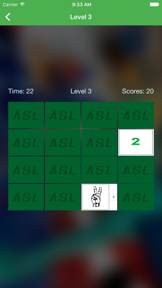
Interactive games for words and numbers to reinforce sign recognition.
100 basic signs demonstrated via video for family, place, and time vocabulary.
How much does it cost?
Monetization relies entirely on ad-supported inventory within a free-to-play educational structure.
Velocity
Maintenance developmentperformancemonetizationShow more...
The app has released 4 updates over the last 6 months, but the cadence is heavily skewed by a long period of inactivity between December 2024 and October 2025. The current release pattern is approximately 0.15 releases per week, placing it firmly in the maintenance tier. Development is currently focused on minor performance and stability improvements rather than new features. The publisher has shifted the app to a free model, but no new functional features have been introduced in the recent build history.
Who built it?
User Sentiment
What do users think recently?
Review voice lately leans excited. Users appreciate free access to sign language learning materials removes financial barriers for students and families and video-based lessons provide an effective way for beginners to memorize signs at their own pace, but report video playback limitations prevent users from slowing down demonstrations to observe complex hand movements.
How are ratings & reviews evolving?
What users say, by theme
- Free access to sign language learning materials removes financial barriers for students and families
- Video-based lessons provide an effective way for beginners to memorize signs at their own pace
- Practical application of sign language helps users communicate with nonverbal children and hard of hearing peers
- Video playback limitations prevent users from slowing down demonstrations to observe complex hand movements
62 of 99 recent reviews analyzed · high confidence · Excited overall
Read the full review analysisUnlock 2 more frustration themes and 1 user request, each backed by review evidence.
Access the full report for freeCompetition
Competitive landscape for ASL American Sign Language
How's the Education market?
ASL American Sign Language occupies a specialized niche in the Education category, maintaining a 4.47 rating on iOS across 3,044 reviews. Its free-to-play model provides a competitive advantage in acquisition, though the lack of updates since 2016 limits its ability to compete with high-velocity language-learning rivals.
Read the market outlookThe rivals identified

By BNR Languages
This app competes for the same language-learning demographic by utilizing a high-frequency, gamified flashcard-based approach to vocabulary and phrase acquisition.
- Offers native audio playback which provides critical auditory reinforcement missing from our static visual flashcards.
- Includes a dedicated review mode that helps users retain long-term knowledge through spaced repetition cycles.
- Provides a fully functional offline course, allowing users to learn without needing a constant data connection.
 Learn Persian (Beginners)Contender
 Learn Hindi (Beginners)Contender
 Learn Arabic (Beginners)Contender
 Write It! ArabicContender
Unlock the head-to-head verdict: where this rival wins, and where it loses.
Access the full report for freeThe Analyst's Read
Key takeaways for ASL American Sign Language
Where is it heading?
The education market is consolidating around apps that offer structured, gamified curricula with native audio support. ASL American Sign Language remains stable due to its niche focus, but the lack of feature investment will likely lead to gradual churn as users seek more interactive alternatives.
- The nine-year gap in major feature releases indicates a maintenance-only posture, which leaves the app vulnerable to rivals with active development cycles.
- High user sentiment regarding the free, ad-supported model suggests that the current monetization structure successfully removes financial barriers for the target audience.
The SWOT
- Privacy-first design removes data-collection friction
- Niche focus on ASL reduces direct competition
- Implement spaced-repetition review modes
- Add native audio for pronunciation reinforcement
Next best moves
Ship video playback speed controls because users report difficulty following complex hand movements → increase learning efficacy
+ 1 more prioritized moveThe counter-intuitive read
The app's lack of updates is its primary retention lever…
Read the full takeFeature gaps
Native audio playback (available in Learn Japanese - Beginners but missing here) +2
Since the last report: The app has shifted from a growth-oriented roadmap to a reactive maintenance posture, prioritizing the resolution of in-app purchase failures and video playback limitations. This pivot reflects a decline in functional reliability that now overshadows the previous focus on content expansion.
Bottom line
ASL American Sign Language retains core users through its free, privacy-focused access to foundational signs, but the lack of feature evolution threatens its long-term viability. Addressing video playback and purchase reliability would unlock the retention potential currently stifled by technical friction.
Unlock 3 critical frictions, 2 market threats, 1 more prioritized move and the analyst’s take.
Access the full report for freeFAQ
Is ASL American Sign Language good for beginners?
How does ASL American Sign Language compare to other language apps?
Does ASL American Sign Language have intrusive ads?
What is a free alternative to ASL American Sign Language?
Sources
- [1] Play Store listing, source
Report last updated