



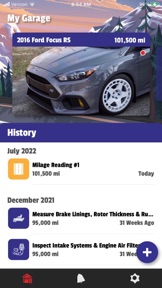


AutoCare+ is a vehicle maintenance tracking app for iOS that enables users to log service history, decode VINs, and predict future maintenance needs.
The App DNA
What makes this app unique?
Users hire AutoCare+ to manage the complexity of vehicle ownership and prevent costly repairs through proactive, mileage-based scheduling.
For Vehicle owners who perform their own maintenance or want to track detailed service history and repair costs.
What does it look like?
Key features
Automatically retrieves vehicle engine details and country of origin from a scanned or entered VIN
Configures recurring maintenance alerts based on vehicle mileage
In-app purchase providing OEM-specific service requirements and repair difficulty data for US and CA vehicles
Estimates future mileage and maintenance dates based on the previous year of driving history
How much does it cost?
Freemium model gates proactive maintenance features and OEM data behind in-app purchases to monetize long-term vehicle management.
Velocity
Dormant developmentUX improvementsperformanceShow more...
The app has not received a release in over 18 months, indicating a complete cessation of development activity. With only a single version provided in the history, there is no evidence of ongoing maintenance or feature updates. The project currently shows no signs of active development or operational support.
Who built it?
David Smith
5 apps tracked · Lifestyle
 Space Pixel Swarm
 Video Coach
 Guitar Tap
 No Time For Math
User Sentiment
What do users think recently?
How are ratings & reviews evolving?
Not enough recent reviews to extract reliable themes yet.
Read the full review analysisCompetition
Competitive landscape for AutoCare+
How's the Lifestyle market?
AutoCare+ maintains a 4.0-star rating on the iOS platform with a focus on manual maintenance logging. The lack of recent feature updates relative to the competitive entry of hardware-linked apps signals a risk of stagnation in the utility segment.
Read the market outlookThe rivals identified

By Tatu.mobi
Carango is a direct competitor that dominates the vehicle management space by offering comprehensive expense tracking and data analytics, directly overlapping with AutoCare+'s goal of historical maintenance record-keeping.
- Offers robust data analytics and reporting features that provide deeper financial insights than AutoCare+'s basic tracking.
- Maintains a massive user base and long-standing market presence, creating a significant barrier to entry for new users.
- Includes integrated expense and income tracking, turning a simple maintenance log into a comprehensive vehicle financial management tool.
 Mileage Tracker for Fuel IQContender
 Amcrest GPS FleetContender
 CarNerdContender
 Simply Fleet: Fleet ManagementContender
Unlock the head-to-head verdict: where this rival wins, and where it loses.
Access the full report for freeThe Analyst's Read
Key takeaways for AutoCare+
Where is it heading?
Users report: The automotive utility market is shifting toward automated data ingestion, leaving manual-entry apps like AutoCare+ exposed to churn. The PM must pivot to hardware integration to maintain relevance against diagnostic-first competitors.
- The entry of hardware-integrated diagnostic apps pulls technical users away from manual logging, which threatens the long-term viability of the current feature set.
- Recent updates focused on maintenance and stability rather than feature expansion, signaling a period of consolidation rather than aggressive market growth.
The SWOT
- Predictive mileage algorithm converts raw odometer data into actionable service windows
- VIN decoding provides high-accuracy onboarding for new vehicle entries
- Integration with third-party OBD-II hardware could automate mileage and diagnostic data ingestion
- Expansion into non-US/CA markets for OEM maintenance schedules would unlock global growth
Next best moves
Integrate OBD-II Bluetooth support because manual entry is the top friction point → increase daily active usage
+ 1 more prioritized moveThe counter-intuitive read
The app's reliance on manual entry is a feature, not a bug…
Read the full takeFeature gaps
Real-time OBD-II diagnostic integration (available in Amcrest GPS Fleet but absent here) +1
Since the last report: The app has pivoted its strategic roadmap from addressing antique vehicle support to countering hardware-integrated diagnostic competitors through planned OBD-II support.
Bottom line
AutoCare+ provides a solid manual tracking foundation, but it lacks the automated diagnostic depth of modern competitors, so the PM should prioritize OBD-II integration to prevent churn to hardware-linked alternatives.
Unlock 2 critical frictions, 2 market threats, 1 more prioritized move and the analyst’s take.
Access the full report for freeReport last updated