


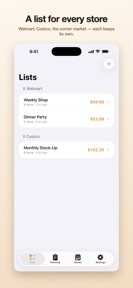

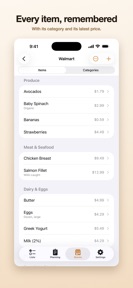


BAGL is a grocery list manager for iOS that organizes items by store, aisle, and historical price point.
The App DNA
What makes this app unique?
It removes the cognitive cost of remembering which store carries specific items at the lowest price, displacing generic note-taking apps that lack store-specific context.
For Budget-conscious shoppers who frequent multiple grocery stores and want to track item pricing and aisle organization.
What does it look like?
Key features
Maintains unique item lists, aisle order, and pricing history for individual grocery stores.
Records item prices over time to identify deals and calculate total cart costs before checkout.
Aggregates items across multiple store catalogs to identify the cheapest purchase location.
How much does it cost?
The freemium model gates advanced utility like iCloud sync and widgets behind a Pro tier while keeping core list functionality free.
Velocity
Steady developmentopaqueperformanceShow more...
BAGL - Bring a Grocery List maintains a steady development pace, shipping two updates within the observed window. The latest release follows a minor update from late August, focusing on general refinements rather than new feature sets. Development appears stable, though the changelogs remain opaque regarding specific functional changes. The current cadence suggests a consistent, low-frequency maintenance cycle.
Who built it?
User Sentiment
What do users think recently?
How are ratings & reviews evolving?
Not enough recent reviews to extract reliable themes yet.
Read the full review analysisCompetition
Competitive landscape for BAGL - Bring a Grocery List
How's the Productivity market?
BAGL competes in the productivity category by offering store-specific price tracking, a feature absent in standard list apps. The current release cadence of one update every two weeks signals active development, though the app lacks the large-scale review volume of established category incumbents.
Read the market outlookThe rivals identified
Unlock the deeper market read.
Access the full report for freeThe Analyst's Read
Key takeaways for BAGL - Bring a Grocery List
Where is it heading?
The grocery list category is shifting toward integrated retail experiences that automate pricing. BAGL's manual-first approach is currently advantaged by its store-agnostic independence, but it must reduce input friction to survive against retail-owned apps that offer seamless price integration.
- The consistent two-week update cadence indicates active feature investment rather than maintenance-only support.
- The focus on store-specific data ownership differentiates BAGL from generic list apps, though it requires high user effort to reach full utility.
The SWOT
- Store-specific catalogs create high switching costs for users
- Price tracking history encourages recurring weekly app usage
- Planning mode provides utility as a pre-shopping decision tool
- Automated price-comparison suggestions could increase Pro tier value
- Integration with retail loyalty programs would reduce manual entry
- Expansion into shared household lists would drive organic growth
Next best moves
Ship automated price-entry via receipt scanning because manual entry is the primary friction point → increase user retention
+ 1 more prioritized moveThe counter-intuitive read
The manual data entry requirement is not a weakness but a retention mechanism…
Read the full takeBottom line
BAGL's store-specific price tracking creates a defensible niche, but the manual data entry requirement remains a significant churn risk. Automating this input would unlock the app's potential as a primary household budgeting tool, justifying the Pro subscription for casual users.
Unlock 3 critical frictions, 3 market threats, 1 more prioritized move and the analyst’s take.
Access the full report for freeFAQ
Is BAGL better than a standard notes app for grocery lists?
Does BAGL automatically update prices from grocery stores?
What features are included in the free version of BAGL?
Sources
- [1] App Store, source
Report last updated