





Battle.net is a companion app for Blizzard Entertainment players, providing account security, social connectivity, and support access on iOS and Android.
The App DNA
What makes this app unique?
Users hire the app to secure their game licenses and coordinate play sessions, but the current authentication friction prevents the app from delivering on its core promise of reliable account access.
For Existing Blizzard Entertainment players who require account security, social connectivity, and support access while away from their desktop.
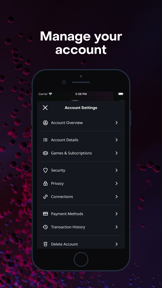
What does it look like?
Key features
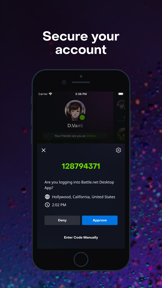
Two-factor authentication for account security via push notifications or button taps
Real-time status updates on friends' activity, chat, and group coordination
Direct access to browse and purchase Blizzard games and digital products
How much does it cost?
The app functions as a free utility to support the broader Blizzard game ecosystem, with no direct monetization within the mobile interface.
Velocity
Maintenance developmentUX improvementssocial featuresperformanceShow more...
The app currently ships at a maintenance cadence of approximately 0.15 releases per week, with significant gaps between updates. Development is stable but infrequent, focusing on incremental UX improvements and performance optimizations rather than rapid feature iteration. The latest release continues this trend by refining existing social and media viewing capabilities. There is no evidence of a live-ops strategy or high-frequency feature deployment.
Who built it?
Blizzard Entertainment
6 apps tracked · Entertainment
 Hearthstone
 炉石传说
炉石传说 Overwatch Rush
 Diablo Immortal
 Warcraft Rumble
User Sentiment
What do users think recently?
Recent user voice shows an upset sentiment. Users appreciate core gameplay loop provides consistent entertainment value for long-term players, but report authentication and login loops prevent users from accessing their accounts post-update.
How are ratings & reviews evolving?
What users say, by theme
- Core gameplay loop provides consistent entertainment value for long-term players
- Authentication and login loops prevent users from accessing their accounts post-update
100 of 151 recent reviews analyzed · high confidence · Upset overall
Read the full review analysisUnlock 1 user request, each backed by review evidence.
Access the full report for freeCompetition
Competitive landscape for Battle.net
How's the Entertainment market?
Battle.net maintains a niche utility position within the Entertainment category, but the 3.55 Android rating significantly lags behind the 4.64 iOS rating. This divergence signals that technical instability on the Android build is actively eroding the user base.
Read the market outlookThe rivals identified

By Microsoft Corporation
Xbox serves as the primary cross-platform social hub for gamers, matching the Battle.net mission of staying connected to friends and game status.
- Integrates deep console-to-mobile remote play features that bridge the gap between living room and mobile.
- Provides a unified social feed that aggregates achievements and clips across the entire Xbox ecosystem.
- Supports native party chat and voice communication directly within the mobile app interface.


Unlock the head-to-head verdict: where this rival wins, and where it loses.
Access the full report for freeThe Analyst's Read
Key takeaways for Battle.net
Where is it heading?
The mobile gaming social space is consolidating around platform-agnostic tools that offer higher fidelity and lower friction. Battle.net's maintenance-mode updates leave it exposed to further churn as players prioritize stable access over proprietary security features.
- Authentication loops in the latest update trap users in browser redirects, which compounds the rating drag already visible on Android.
- Automated support tickets closing without human intervention drives user frustration, accelerating churn pressure on long-term players into Q2.
The SWOT
- Proprietary authenticator protects high-value account assets
- Direct support ticket access reduces technical churn
- Unified Blizzard ecosystem news feed
- Integrate standard third-party authenticator protocols
- Implement voice chat for mobile coordination
Next best moves
Rebuild login handshake because authentication loops are the #1 churn driver → recover login success rate
+ 1 more prioritized moveThe counter-intuitive read
The proprietary authenticator is a liability, not a moat…
Read the full takeFeature gaps
Voice chat (available in Discord but absent here) +1
Since the last report: The app is experiencing a decline in user sentiment due to persistent authentication failures, forcing a shift in development priority from feature expansion to core stability.
Bottom line
Battle.net provides essential account security, but the current authentication friction actively prevents users from accessing their games, so the PM must prioritize login stability to prevent further churn to platform-agnostic social alternatives.
Unlock 3 critical frictions, 3 market threats, 1 more prioritized move and the analyst’s take.
Access the full report for freeReport last updated