








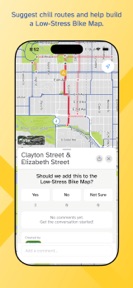


Bike Streets is a navigation app for urban cyclists that crowdsources low-stress, quiet routes to avoid high-traffic thoroughfares.
The App DNA
What makes this app unique?
It removes the cognitive cost of planning safe bike routes in cities where mainstream navigation prioritizes car speed over cyclist safety.
For Urban cyclists and local advocates seeking safe, low-stress routes and wanting to influence municipal bike infrastructure investment.
What does it look like?
Key features
Crowdsourced navigation prioritizing quiet streets over shortest-distance car routes.
In-app functionality for users to manage infrastructure data and route suggestions.
Aggregates usage data to support local advocacy and infrastructure lobbying.
How much does it cost?
The app operates as a free, community-supported project with an optional donation model for users to back the development.
Velocity
Maintenance developmentUX improvementsShow more...
The app currently operates at a maintenance cadence, with only one release shipped in the observed window. The latest version focuses on administrative utility, allowing Network Editors to decline specific route and construction suggestions. Development appears stable but limited to minor functional refinements rather than significant feature expansion. The current release frequency of approximately one update every 17 days reflects a focus on targeted maintenance.
Who built it?

User Sentiment
What do users think recently?
Recent user voice shows an excited sentiment. Users appreciate low-stress routing algorithms prioritize quiet neighborhood streets over high-traffic thoroughfares to improve cyclist safety and community-driven map updates allow local cyclists to contribute verified safe paths and improve routing accuracy.
How are ratings & reviews evolving?
What users say, by theme
- Low-stress routing algorithms prioritize quiet neighborhood streets over high-traffic thoroughfares to improve cyclist safety
- Community-driven map updates allow local cyclists to contribute verified safe paths and improve routing accuracy
- Exploration features like the wander mode encourage aimless riding and discovery of new city corners
- Subscription pricing is perceived as too high for the current geographic coverage and feature set
36 of 36 recent reviews analyzed · high confidence · Excited overall
Read the full review analysisUnlock 2 more frustration themes and 2 user requests, each backed by review evidence.
Access the full report for freeCompetition
Competitive landscape for Bike Streets
How's the Navigation market?
Bike Streets operates within the navigation category, maintaining a 4.68-star rating across 174 total platform ratings. The focus on low-stress routing differentiates the app from mainstream navigation tools that lack specialized cyclist safety data.
The rivals identified
The Analyst's Read
Key takeaways for Bike Streets
Where is it heading?
The navigation market is consolidating around mainstream tools, leaving niche safety-focused apps like Bike Streets exposed if they cannot maintain high session reliability. The current focus on administrative tools is a positive signal, but the PM must prioritize session stability to prevent churn before the next expansion phase.
- Recurring crashes during active ride sessions hinder reliability, which erodes the daily active habit and drives negative sentiment.
- The latest release adds administrative tools for network editors, showing active feature investment rather than maintenance-only mode.
The SWOT
- Crowdsourced low-stress routing algorithms prioritize quiet streets
- Network editor tools enable community-driven map updates
- Automated ride-end detection to prevent inaccurate logs
- Guest mode to lower friction for new users
Next best moves
Ship auto-shutoff ride detection because stationary logs are a top-requested fix → improve data accuracy
+ 1 more prioritized moveThe counter-intuitive read
The app's reliance on community-driven map data is a liability in low-density areas…
Read the full takeSince the last report: The strategic outlook shifted from stable to mixed, reflecting heightened concern over technical reliability and the scalability of the crowdsourced data model in low-density regions.
Bottom line
Bike Streets' low-stress routing mechanism provides a clear safety advantage, but technical instability and registration friction currently cap user retention. Addressing these reliability gaps is the necessary move to ensure the crowdsourced map data remains viable against mainstream rivals.
Unlock 3 critical frictions, 2 market threats, 1 more prioritized move and the analyst’s take.
Access the full report for freeFAQ
Is Bike Streets better than Google Maps for cycling?
Does Bike Streets require an account to use?
Is Bike Streets free to use?
Sources
- [1] App Store, source
Report last updated