


BillRadar: Bill Reminder
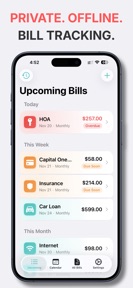



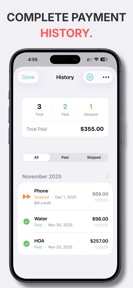

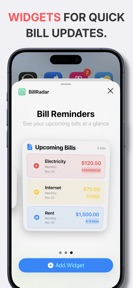


BillRadar is a local-only bill tracking app for iOS that allows users to manage rent, utilities, and subscriptions without bank linking or cloud accounts.
The App DNA
What makes this app unique?
The app removes the cognitive and security friction of connecting bank accounts, serving users who prioritize data sovereignty over automated synchronization.
For Privacy-conscious individuals who prefer manual, offline financial tracking over automated bank-linked services.
What does it look like?
Key features
All bill information resides on the device with no cloud-based account requirement.
Optional Face ID or Touch ID lock for accessing financial records.
Automatically marks bills as paid on the due date.
How much does it cost?
Monetization relies on a one-time purchase model, targeting users who prefer avoiding ongoing costs.
Velocity
Maintenance developmentUX improvementsmonetizationShow more...
BillRadar currently operates at a maintenance cadence, with only one release shipped in the last 31 days. The latest version introduced functional improvements including Autopay automation and data portability via CSV export. Development appears focused on core utility rather than rapid iteration or live operations. Given the current pace, the app remains in a stable maintenance state.
Who built it?
Buknal Enterprise
3 apps tracked · Finance
 Telcoo - Cable Pair Tool
 TimeConvertr
User Sentiment
What do users think recently?
How are ratings & reviews evolving?
Not enough recent reviews to extract reliable themes yet.
Read the full review analysisCompetition
Competitive landscape for BillRadar: Bill Reminder
How's the Finance market?
BillRadar operates as a niche utility in the Finance category, relying on a 3.8-star rating across a small sample of 5 reviews. The absence of bank-linking differentiates the app from mainstream automated trackers, though it limits the potential for high-frequency engagement.
Read the market outlookThe rivals identified
Unlock the deeper market read.
Access the full report for freeThe Analyst's Read
Key takeaways for BillRadar: Bill Reminder
Where is it heading?
The personal finance market is consolidating around automated, bank-linked platforms that reduce user effort. BillRadar remains advantaged in the privacy-conscious segment but faces a growth ceiling unless it introduces features that reduce manual entry friction without compromising its offline-first promise.
- The 31-day update cadence indicates a stable, maintenance-focused development cycle rather than an aggressive feature expansion strategy.
- The recent addition of CSV export capabilities addresses a key data-portability concern for power users who manage complex financial records.
The SWOT
- Local-only storage architecture removes third-party data exposure risks
- Automated PDF bill scanning could reduce manual entry friction
Next best moves
Ship automated PDF bill scanning because manual entry is the primary friction point → increase user retention
The counter-intuitive read
The lack of bank-linking is not a feature gap but a retention lever…
Read the full takeSince the last report: BillRadar has pivoted its strategic focus toward reducing manual entry friction via automated PDF scanning, while simultaneously acknowledging that its one-time purchase model constrains the capital available for rapid feature iteration.
Bottom line
BillRadar's privacy-first, local-only architecture serves a specific, security-focused segment that automated rivals ignore. Prioritizing utility features like automated scanning would unlock growth among users who currently find manual entry too time-consuming.
Unlock 1 critical friction, 1 market threat and the analyst’s take.
Access the full report for freeSources
- [1] App Store
Report last updated