


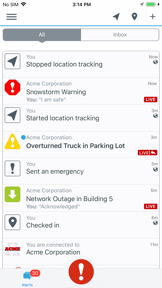


BlackBerry AtHoc is a crisis communication app for enterprise and government users, structured around emergency alerts and field reporting.
The App DNA
What makes this app unique?
Organizations hire AtHoc to maintain safety compliance and situational awareness during incidents, but the current onboarding friction forces users to abandon the tool when registration fails.
For Government agencies, public safety organizations, and critical infrastructure enterprises requiring secure, large-scale crisis communication.
What does it look like?
Key features
Two-way communication system for receiving and acknowledging emergency alerts via mobile push
Upload images and videos from the field to the operations center for situational awareness
One-click emergency signal transmission to notify operations centers of immediate danger
How much does it cost?
B2B model gated by organization-wide deployment, requiring an administrator-provided code for access.
Velocity
Maintenance developmentopaqueperformanceShow more...
The app currently ships at a cadence of approximately 0.14 releases per week, placing it in the maintenance tier. Development is characterized by infrequent, minor stability updates with no evidence of new features or live operations. The publisher utilizes opaque release notes, providing no insight into specific technical improvements or roadmap direction. The current release pattern suggests a focus on long-term stability rather than active feature development.
Who built it?
User Sentiment
What do users think recently?
Fresh user feedback skews frustrated. Users appreciate corporate mass notification system provides reliable emergency communication when correctly integrated with organizational infrastructure, but report registration and activation failures prevent new users from accessing the service after initial download.
How are ratings & reviews evolving?
What users say, by theme
- Corporate mass notification system provides reliable emergency communication when correctly integrated with organizational infrastructure
- Registration and activation failures prevent new users from accessing the service after initial download
60 of 80 recent reviews analyzed · high confidence · Frustrated overall
Read the full review analysisUnlock 1 more frustration theme and 1 user request, each backed by review evidence.
Access the full report for freeCompetition
Competitive landscape for BlackBerry AtHoc
How's the Business market?
AtHoc occupies the enterprise-grade crisis communication segment, maintaining a 2.25 average rating across 407 total reviews. The significant Android-iOS rating gap signals that the stability issues are disproportionately impacting the larger Android user base, creating a churn risk for field-deployed staff.
Read the market outlookThe rivals identified

By Penguin Management, Inc.
eDispatches remains the primary competitor for mission-critical dispatch alerts, leveraging deep CAD integration to maintain its market position.
- Provides specialized visual response mapping that offers superior situational awareness compared to AtHoc's generic alert interface.
- Deep integration with CAD systems allows for automated, hands-on-free dispatching that reduces manual input requirements for responders.

Unlock the head-to-head verdict: where this rival wins, and where it loses.
Access the full report for freeThe Analyst's Read
Key takeaways for BlackBerry AtHoc
Where is it heading?
The crisis communication market is shifting toward automated, high-velocity dispatch workflows that reduce manual administrative burden. AtHoc remains exposed to these competitors because its current update cadence prioritizes stability over the workflow automation that field responders demand, so the platform risks losing its relevance for frontline incident management.
- Persistent loading errors and registration loops in the latest release force users into reinstallation cycles, which compounds the rating drag on Android.
- Recent updates focused on stability and minor enhancements, indicating the team is in maintenance mode rather than aggressive feature expansion.
The SWOT
- Enterprise-grade security framework satisfies government compliance requirements
- Unified platform architecture centralizes mass notification, duress, and GPS tracking
- Integrate automated CAD-triggering workflows to reduce time-to-alert
- Implement granular notification settings to prevent audio overrides
Next best moves
Rebuild registration flow because activation failures are the #1 onboarding barrier → increase successful user activation
+ 1 more prioritized moveThe counter-intuitive read
The app's enterprise-gated model is not a weakness but a moat…
Read the full takeFeature gaps
Automated CAD-triggering workflows (available in eDispatches but missing here) +1
Since the last report: The analysis now centers on onboarding and notification friction as the primary drivers of user churn, moving away from generic performance complaints.
Bottom line
AtHoc holds a secure enterprise position through compliance, but it bleeds field users due to onboarding and notification friction, so the PM must prioritize registration stability to prevent churn.
Unlock 3 critical frictions, 2 market threats, 1 more prioritized move and the analyst’s take.
Access the full report for freeReport last updated