


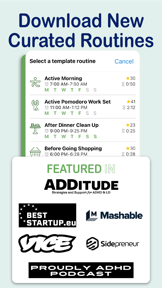


Brili Routines is a visual planner and timekeeper for ADHD users, structured around gamified task playlists on iOS and Android.
The App DNA
What makes this app unique?
The app removes the cognitive friction of task initiation by visualizing time progression, which helps users manage the anxiety of daily transitions.
For Individuals with ADHD or ADD seeking structured, gamified tools to manage time blindness and daily task transitions.
What does it look like?
Key features
Dynamic clock interface calculating time remaining for active tasks, acting as a cognitive anchor for neurodivergent users.
Gamified achievement system providing tangible incentives for completing multi-step routines.
Sequenced task lists that automate daily transitions, reducing daily cognitive load.
How much does it cost?
Subscription-only model anchored at $49.99/year, utilizing a 10-day trial to demonstrate routine-building value before conversion.
Velocity
Maintenance developmentperformanceUX improvementsShow more...
With the latest release occurring 246 days ago, the app is currently in a maintenance phase. Development has been limited to stability and performance patches, with no new features introduced since early 2025. The cadence has effectively stalled, as the last ten versions were released over a period that suggests a lack of active feature development.
Who built it?
User Sentiment
What do users think recently?
Recent user voice shows a mixed sentiment. Users appreciate visualizing time progression through routine timers helps neurodivergent users manage chronic lateness and task transitions and customizable routine structures allow users to automate complex multi-step tasks and reduce daily cognitive load, but report frequent app freezes and launch failures following the latest update prevent users from accessing their routines.
How are ratings & reviews evolving?
What users say, by theme
- Visualizing time progression through routine timers helps neurodivergent users manage chronic lateness and task transitions
- Customizable routine structures allow users to automate complex multi-step tasks and reduce daily cognitive load
- The reward system using stars provides tangible motivation for users struggling with task initiation
- Frequent app freezes and launch failures following the latest update prevent users from accessing their routines
71 of 130 recent reviews analyzed · high confidence · Mixed overall
Read the full review analysisUnlock 2 more frustration themes and 3 user requests, each backed by review evidence.
Access the full report for freeCompetition
Competitive landscape for Brili Routines – Habit Tracker
How's the Productivity market?
Brili Routines competes in the productivity space, currently holding a 3.99 rating on Android and 4.65 on iOS. The disparity in platform ratings, combined with a 274-day gap since the last major feature update, indicates that technical debt is currently outpacing feature development.
Read the market outlookThe rivals identified

By Recruit Co.,Ltd.
While focused on shift management, this app competes for the same time-blocking and routine-conscious user base that relies on structured scheduling to manage daily obligations.
- Deep integration with Air Shift platform provides a massive, built-in user acquisition channel for workers.
- Automated salary calculation features provide tangible financial utility that Brili lacks in its current routine-focused model.
- Massive review volume and established market presence create a significant barrier to entry for new competitors.
 SynchroteamContender
 Work MobileContender
 Service AutopilotContender
 Clientes, Vendas e OrçamentosContender
Unlock the head-to-head verdict: where this rival wins, and where it loses.
Access the full report for freeThe Analyst's Read
Key takeaways for Brili Routines – Habit Tracker
Where is it heading?
The productivity market is consolidating around tools that provide multi-device consistency, leaving Brili Routines exposed to churn. Unless the developer prioritizes cloud-syncing and stability over new features, the current user base will likely migrate to more reliable alternatives.
- Frequent launch freezes following the latest update prevent users from accessing routines, which erodes trust in the app's reliability.
- The visual timer remains a highly praised differentiator that effectively reduces decision fatigue for the neurodivergent user base.
The SWOT
- Visual timer interface acts as a cognitive anchor for neurodivergent users
- Gamified reward system provides tangible motivation for task initiation
- Native smartwatch integration would capture users who misplace phones mid-task
- Home screen widgets would provide visual reminders without requiring app entry
Next best moves
Ship cloud-syncing infrastructure because it is the top-requested feature → reduce churn among multi-device users
+ 1 more prioritized moveThe counter-intuitive read
The app's reliance on local-only data is a feature for privacy-conscious ADHD users…
Read the full takeFeature gaps
Cross-device data syncing (available in Yandex Calendar but missing here) +1
Since the last report: The competitive narrative has hardened, shifting from a neutral view of local-only storage to identifying it as a critical retention flaw, while the outlook on competitive pressure from DayBlocks has intensified.
Bottom line
Brili Routines retains core users through its ADHD-specific visual timer, but the lack of cloud-syncing and recent stability regressions cap its growth. Addressing these technical barriers would unlock the retention needed to justify the $49.99 annual price point.
Unlock 3 critical frictions, 2 market threats, 1 more prioritized move and the analyst’s take.
Access the full report for freeSources
- [1] Play Store listing, source
Report last updated