








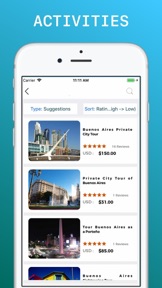
Buenos Aires Travel Guide is an offline-first travel utility for iOS users, offering regional maps, itineraries, and AR-based point-of-interest discovery.
The App DNA
What makes this app unique?
The app removes the financial friction of roaming charges for international travelers by ensuring all navigation and logistical data remains accessible without an internet connection.
For Independent travelers visiting Buenos Aires and surrounding regions who require offline navigation and local logistical support.
What does it look like?
Key features
Full access to regional maps without internet, serving as a critical utility for avoiding roaming fees.
360-degree discovery of points of interest, acting as a standard navigation aid.
How much does it cost?
The app uses a free-to-download model with IAPs, which lacks the conversion-focused booking engine seen in modern travel competitors.
Velocity
Steady developmentShow more...
Who built it?
Gonzalo Juarez
13+ apps tracked · Travel
 Metropolitan Museum of Art NYC
 Istanbul Travel Guide .
 Barcelona Travel Guide -
 Miami Travel Guide
 Vienna Travel Guide .
 Florence Travel Guide Offline
 Hong Kong Travel Guide ..
 Rijksmuseum Visitor Guide
 Venice Travel Guide ..
 Seoul Travel Guide
 Madrid Travel Guide ..
 Istanbul Travel City Guide
User Sentiment
What do users think recently?
How are ratings & reviews evolving?
Not enough recent reviews to extract reliable themes yet.
Read the full review analysisCompetition
Competitive landscape for Buenos Aires Travel Guide
How's the Travel market?
Buenos Aires Travel Guide maintains a niche position as a specialized offline utility, though its 1260-day update gap limits its competitive standing against modern, frequently updated travel guides.
Read the market outlookThe rivals identified

By The National Trust
This app competes for the same 'offline-first' travel discovery audience, positioning itself as the primary utility for location-based exploration and site-specific information.
- Leverages a massive, established physical footprint of properties that creates an insurmountable barrier to entry.
- Provides deep, curated historical content that goes far beyond the basic POI data in our guide.
 Discover Durham, NCContender
 Moj izletContender
 FLORENCE Travel Guide & MapContender
 НЕАПОЛЬ Путеводитель и КартаContender
Unlock the head-to-head verdict: where this rival wins, and where it loses.
Access the full report for freeThe Analyst's Read
Key takeaways for Buenos Aires Travel Guide
Where is it heading?
The travel guide market is consolidating around dynamic, content-rich apps that integrate booking and real-time data. Buenos Aires Travel Guide's lack of updates leaves it exposed to more agile competitors that offer fresher, more immersive experiences.
- The 1260-day update gap indicates a maintenance-only posture, which erodes the app's value as a reliable travel guide for repeat visitors.
The SWOT
- 100% offline map packs remove the connectivity dependency rivals require
- Localized itinerary expansion into the Colonia region
Next best moves
Audit POI data because the 1260-day update gap risks providing obsolete information to travelers → maintain utility baseline
The counter-intuitive read
The 1260-day update gap is a competitive advantage…
Read the full takeFeature gaps
Professional audio guides (available in FLORENCE Travel Guide & Map but absent here) +1
Since the last report: The outlook has transitioned to declining due to the 1260-day update gap, which now serves as the primary anchor for competitive risk assessment. This shift prioritizes content accuracy and maintenance over previous discussions of itinerary management.
Bottom line
The offline-first utility remains a defensible niche, but the 1260-day update gap risks brand irrelevance. Prioritizing a content refresh over new feature development will protect the app's utility against modern, editorial-led competitors.
Unlock 1 critical friction, 1 market threat and the analyst’s take.
Access the full report for freeFAQ
Does Buenos Aires Travel Guide work without an internet connection?
How does Buenos Aires Travel Guide compare to modern travel apps?
Is Buenos Aires Travel Guide safe to use for navigation?
What is a free alternative to Buenos Aires Travel Guide?
Sources
- [1] App Store, source
Report last updated