


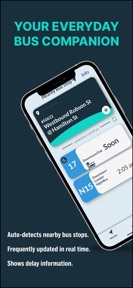



TAMAKI is a real-time bus tracking app for Canadian commuters that provides arrival predictions through a map-free, stop-code interface on iOS and Android.
The App DNA
What makes this app unique?
The app removes the cognitive load of map-based transit tools, serving riders who need immediate, accurate arrival times for their saved daily routes.
For Daily bus commuters in Canada, including students and professionals, who require fast and accurate arrival updates.
What does it look like?
Key features
Uses official transit agency data to provide live arrival predictions for bus routes.
Calculates arrival times using predictive algorithms to account for early or delayed buses.
Supports multiple languages including English and French for diverse user bases.
How much does it cost?
The ad-supported model requires high-frequency daily usage to generate revenue from impressions.
Velocity
Maintenance developmentopaqueShow more...
With the latest release occurring 166 days ago, the app is currently in a maintenance phase. Development activity is minimal, consisting only of minor, non-descript local updates that provide no insight into new features or functional improvements. There is no evidence of active live-ops or ongoing feature development, and the current cadence suggests a lack of active product iteration.
Who built it?
User Sentiment
What do users think recently?
How are ratings & reviews evolving?
Not enough recent reviews to extract reliable themes yet.
Read the full review analysisCompetition
Competitive landscape for Bus Arrival time tracer:TAMAKI
How's the Navigation market?
TAMAKI operates in the Canadian transit utility space, competing against established regional transit agency apps. The lack of recent updates over the last 167 days limits its ability to capture market share from more active competitors.
Read the market outlookThe rivals identified
Unlock the deeper market read.
Access the full report for freeThe Analyst's Read
Key takeaways for Bus Arrival time tracer:TAMAKI
Where is it heading?
Users report: The Canadian transit app market is consolidating around agencies that provide high-frequency, reliable data updates. TAMAKI's current maintenance-mode posture leaves it exposed to churn if it fails to address the lack of recent feature investment.
- The five-month development silence suggests the app is in maintenance mode, which reduces its ability to compete with active transit rivals.
- The core AI-powered travel estimation remains a differentiator, provided the underlying GTFS data integration remains accurate and reliable.
The SWOT
- AI-powered travel estimation provides a technical edge over static schedule apps
- Localized French-language support creates a barrier to entry for competitors lacking bilingual interfaces
Next best moves
Ship a stability-focused update because the five-month development gap risks user attrition → defend against churn
The counter-intuitive read
The map-free interface is a retention lever for commuters who know their routes…
Read the full takeSince the last report: TAMAKI's competitive narrative has shifted from a general focus on transit aggregators to a specific focus on regional transit agency apps. While the product remains in a maintenance state, the SWOT analysis and FAQ content have been updated to better define the app's technical requirements and competitive barriers.
Bottom line
TAMAKI's map-free interface serves a clear commuter need, but the five-month development gap risks user attrition to more frequently updated transit alternatives. Prioritizing a stability-focused update would defend the current user base against churn.
Unlock 1 critical friction, 1 market threat and the analyst’s take.
Access the full report for freeFAQ
Is TAMAKI available for all bus agencies in Canada?
Does TAMAKI require an internet connection to work?
What is the difference between TAMAKI and standard transit apps?
Sources
- [1] App Store listing, source
Report last updated