


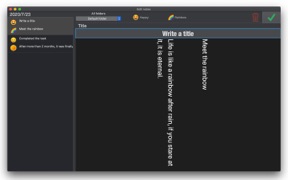


Calendar Notebook - My Journal is a visual, calendar-based journaling app for iOS that prioritizes privacy and simplicity. It differentiates itself through a one-time $5.99 purchase model and iCloud-native syncing, avoiding the subscription-heavy trends of the Lifestyle category. The app's core value proposition is its ability to map text entries, moods, and weather onto a calendar grid for easy pattern recognition.
Product velocity
Dormant
Daily rank 🇺🇸
—
Lifestyle
Sentiment
—
—
Nemesis

Daylio Journal - Mood Tracker
The App DNA
What makes this app unique?
For Individuals looking for a private, organized, and visual way to track their daily life, moods, and habits over time.
What does it look like?
Key features
Visualizes all diary entries directly on a calendar interface for easy navigation.
Provides statistical analysis of mood trends over custom date ranges.
Allows users to log daily mood and weather conditions alongside diary entries.
Organizes diary entries into custom folders for better categorization.
How much does it cost?
The app avoids recurring revenue in favor of a premium, ad-free, and privacy-focused utility model. This appeals to users with 'subscription fatigue' but limits the developer's long-term LTV compared to freemium rivals.
Velocity
Dormant developmentShow more...
The app has not released a version update since September 30, 2024. Given the lack of activity for over 18 months, the app appears to be in a zombie state with no active development. There is no evidence of recent feature additions or maintenance cycles.
Who built it?
永文 胡
13+ apps tracked · Lifestyle
 My Weekly Budget Planner-Save
 Daily Sales Tracker-Inventory
 客戶管理系統 - 顧客聯繫人管理,業務待辦事項App。
 Best Budget Planner-Money Book
 365-day savings plan-Easy Goal
 Daily One Notes-Diary Notebook
 Daily Goals Tracker-Good Habit
 Retail Inventory Manager-Order
 Spending Tracker-Account
 Wallet Money Manager-Expenses
 OmniToDo2 Priority-To do list
 Mood Journal Tracker-Mood Note
User Sentiment
What do users think recently?
How are ratings & reviews evolving?
Not enough recent reviews to extract reliable themes yet.
Read the full review analysisCompetition
Competitive landscape for Calendar Notebook - My Journal
How's the Lifestyle market?
The rivals identified
By Relaxio s.r.o.
The dominant alternative for mood-based journaling with a high-velocity release cadence (11 updates in 6 months).
- Icon-based 'no-typing' entry system vs. this app's text-heavy notebook approach.
- Automated mood statistics and correlation mapping between activities and well-being.
- Freemium model with subscription-locked advanced stats vs. target's $5.99 upfront cost.
 Reflectly - Journal & AI DiaryContender
 Planner & Journal - ZinniaContender
 Gratitude: Self-Care JournalContender
Unlock the deeper market read.
Access the full report for freeThe Analyst's Read
Key takeaways for Calendar Notebook - My Journal
Where is it heading?
- v1.5 (Sept 2024) focused only on bug fixes — indicates maintenance mode rather than active growth.
- 0 ratings and reviews reported — suggests low user acquisition or engagement in the current market.
The SWOT
- Calendar-first visualization for chronological navigation
- One-time purchase model ($5.99) with no recurring fees
- Privacy-focused iCloud sync and password protection
- Integrated mood analytics for trend identification
- Implement AI-generated prompts to solve the 'blank page' problem (Reflectly gap)
- Add creative tools like stickers or templates (Zinnia gap)
- Expand to macOS/Web for cross-platform utility (Evernote gap)
Next best moves
Introduce 'No-Typing' entry options
+ 2 more prioritized movesFeature gaps
Icon-based 'no-typing' entry system (available in Daylio) +4
Bottom line
Calendar Notebook is a solid, privacy-first utility that is currently in maintenance mode. While its one-time purchase model is a strong differentiator against subscription-heavy rivals, it risks total obsolescence unless it addresses the high friction of manual text entry and the lack of AI-driven insights found in market leaders like Daylio and Reflectly.
Unlock 4 critical frictions, 3 market threats, 2 more prioritized moves and the analyst’s take.
Access the full report for freeReport last updated