


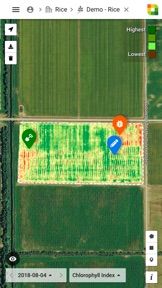
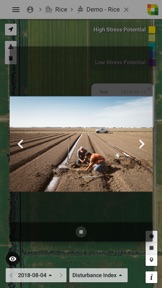


Ceres Imaging is a business-focused aerial imagery platform for agriculture, providing multispectral crop monitoring on iOS.
The App DNA
What makes this app unique?
Growers hire Ceres to identify crop stress and uniformity issues before they impact yield, allowing for targeted resource application that manual scouting cannot achieve.
For Agricultural enterprises, farm managers, insurance adjusters, and lenders requiring data-driven crop and risk analysis.
What does it look like?
Key features
High-resolution aerial imagery for monitoring crop uniformity and water stress
View and compare imagery of fields over time to track crop development
Download imagery for field access without cellular connectivity
How much does it cost?
Monetization relies on B2B enterprise contracts for agribusiness and insurance rather than direct in-app consumer subscriptions.
Velocity
Maintenance developmentperformanceplatform expansionShow more...
The app shows a maintenance-level cadence, with only one release identified in the recent window. The latest version focuses on technical updates, specifically a Mapbox GL upgrade and an Xcode SDK bump, rather than user-facing features. Given the lack of subsequent releases or evidence of live operations, the development trend is currently stagnant. The publisher is prioritizing technical maintenance over feature expansion.
Who built it?
User Sentiment
What do users think recently?
The recent review mood reads excited.
How are ratings & reviews evolving?
Not enough recent reviews to extract reliable themes yet.
Read the full review analysisCompetition
Competitive landscape for Ceres Imaging
How's the Business market?
Ceres Imaging serves the precision agriculture niche with a 4.61 rating, though its lack of direct machine integration limits its footprint compared to broader farm management platforms.
Read the market outlookThe rivals identified

By Poultry Baba
While focused on a different agricultural vertical, this app competes for the same grower attention by providing high-frequency market intelligence and price forecasting tools.
- Provides real-time market rate tracking which Ceres lacks for commodity price-sensitive farming operations.
- High engagement through daily price updates creates a sticky habit loop for agricultural business users.
 xarvio® FIELD MANAGERContender
 Taranis mobileContender
 CropX – Farm ManagementContender
 FieldNETContender
Unlock the head-to-head verdict: where this rival wins, and where it loses.
Access the full report for freeThe Analyst's Read
Key takeaways for Ceres Imaging
Where is it heading?
The precision agriculture market is consolidating around platforms that offer both diagnostic insights and automated execution. Ceres Imaging remains a diagnostic leader, but its lack of machine integration exposes it to churn as growers prioritize platforms that reduce manual labor.
- Competitors like xarvio and FieldNET are adding direct machine integration, which shifts grower preference toward platforms that automate field execution.
- The high rating baseline indicates that the core multispectral imagery product remains highly valued for its diagnostic accuracy.
The SWOT
- High-resolution multispectral imagery reduces input costs [Market Segment]
- Offline mode ensures field-level utility [Platform]
- Integration of ground-truth soil sensor data [Market Opportunity]
- Automated variable-rate application maps [Feature Gap]
Next best moves
Integrate machine-to-field data transfer because competitors like xarvio offer wireless execution → increase operational stickiness
The counter-intuitive read
The reliance on enterprise consultation is a moat, not a weakness…
Read the full takeFeature gaps
Variable rate application maps (available in xarvio FIELD MANAGER but missing here) +2
Since the last report: The report reflects a strategic pivot toward machine-to-field integration as a core requirement to counter operational platforms, accompanied by a more granular competitive landscape analysis.
Bottom line
Ceres Imaging provides high-value diagnostic imagery, but the lack of operational machine integration leaves it vulnerable to competitors like xarvio, so the PM must prioritize hardware-API development to defend the platform's utility.
Unlock 2 critical frictions, 2 market threats and the analyst’s take.
Access the full report for freeReport last updated