


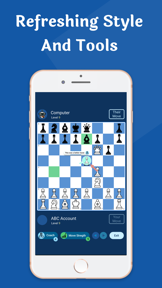
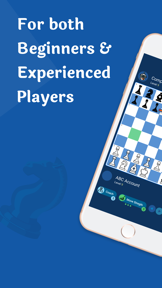

Chess Quest: Play & Learn is a solo-play chess logic game for iOS that offers AI-based difficulty levels and match analysis.
The App DNA
What makes this app unique?
The app removes the social friction of online multiplayer by providing a curated, offline-first environment for casual skill improvement.
For Casual chess players seeking a portable, solo-play logic game for skill improvement.
What does it look like?
Key features
Advanced chess engine with multiple difficulty levels for solo play. Revenue link: Engagement loop for solo users maintains session frequency, increasing ad-inventory per active user.
Provides suggestions for optimal moves during gameplay. Revenue link: Reduces friction for novice players, increasing retention by preventing early-game frustration.
Review and analyze completed matches to learn strategy. Revenue link: Educational value proposition reinforces category authority and user habituation.
How much does it cost?
The app is currently free to play with no explicit subscription or IAP gates identified in the metadata.
Velocity
Dormant developmentopaqueShow more...
The app has not received a public update in over six years, indicating a complete cessation of development activity. The single available version history entry from May 2020 was a minor bug fix, and no subsequent feature releases or maintenance patches have been identified. The project is classified as a zombie due to the extreme duration of inactivity.
Who built it?
User Sentiment
What do users think recently?
Fresh user feedback skews thrilled. Users appreciate mental stimulation provided by chess matches offers a productive way to spend time during quarantine.
How are ratings & reviews evolving?
What users say, by theme
- Mental stimulation provided by chess matches offers a productive way to spend time during quarantine
1 of 1 recent reviews analyzed · limited sample
Read the full review analysisCompetition
Competitive landscape for Chess Quest: Play & Learn
How's the Games market?
Chess Quest: Play & Learn maintains a 4.0-star rating. The lack of recent updates since 2020 signals a maintenance-mode posture that prevents effective competition against active, high-scale rivals.
Read the market outlookThe rivals identified

By Splend Apps
This app is the primary nemesis due to its massive user base and comprehensive feature set that directly overlaps with Chess Quest's core value proposition of learning and playing.
- Offers a robust opening explorer tool that provides deep strategic insights for competitive players
- Maintains a massive, active community enabling real-time online ranked play against global opponents
- Provides a vast library of tactics puzzles that keeps users engaged through daily skill practice
 Chess PremiumContender
 Chess variants - Chess RemixContender
 Chess - Learn, Play & TrainerContender
 Chess!!Contender
Unlock the head-to-head verdict: where this rival wins, and where it loses.
Access the full report for freeThe Analyst's Read
Key takeaways for Chess Quest: Play & Learn
Where is it heading?
The casual chess market is consolidating around platforms that offer both deep analytical tools and massive social network effects. Chess Quest: Play & Learn remains exposed due to its lack of feature expansion, which will continue to erode its relevance against active, high-cadence competitors.
- The six-year release gap indicates a zombie development state, which prevents the app from responding to evolving competitive standards in the chess category.
The SWOT
- Educational game analysis reinforces category authority
- Localized pricing untapped in high-ARPU markets where rivals charge for advanced features
Next best moves
Sunset the product because the six-year release gap indicates a zombie development state → reallocate resources to higher-yield projects.
The counter-intuitive read
The lack of social features is not a…
Read the full takeFeature gaps
Opening explorer tool (available in Chess Online & Offline but missing here) +1
Since the last report: The product outlook shifted from stable to declining, as the six-year development gap is now categorized as a terminal zombie state requiring a sunset recommendation rather than feature iteration.
Bottom line
The six-year development gap invalidates the current product posture, as the lack of active investment prevents any meaningful defense against high-scale rivals. Sunset the app to avoid further brand drag and reallocate resources toward active market opportunities.
Unlock 1 critical friction, 1 market threat and the analyst’s take.
Access the full report for freeFAQ
Is Chess Quest: Play & Learn good for beginners?
How does Chess Quest compare to Chess Online & Offline?
Does Chess Quest: Play & Learn have intrusive ads?
What is a free alternative to Chess Quest?
Sources
- [1] App Store, source
Report last updated