





Clear Balance is a manual-entry debt tracker and repayment planner for UK users on iOS and Android.
The App DNA
What makes this app unique?
The app removes the security friction of linking bank accounts, serving users who prefer total control over their financial data entry.
For UK residents seeking a private, manual-entry tool to organize debt and plan repayment strategies without linking bank accounts.
What does it look like?
Key features
Calculates payoff schedules using Snowball or Avalanche methods.
Records credit cards and loans without bank integration.
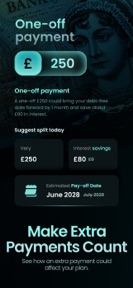
Simulates impact of additional payments on interest costs.
How much does it cost?
Freemium model gates advanced analytical tools like debt-free date projections behind an auto-renewable subscription.
Velocity
Maintenance developmentUX improvementsaccessibilityinternationalizationShow more...
Clear Balance: Debt Tracker currently operates at a maintenance cadence, with only one release shipped in the analyzed window. The latest update introduces improvements to onboarding, accessibility, and expanded debt support, indicating a focus on UX and internationalization rather than rapid feature iteration. Development remains stable but infrequent, with no evidence of live-ops or high-frequency feature deployment. The app continues to prioritize a privacy-first approach without bank connectivity.
Who built it?
User Sentiment
What do users think recently?
How are ratings & reviews evolving?
Not enough recent reviews to extract reliable themes yet.
Read the full review analysisCompetition
Competitive landscape for Clear Balance: Debt Tracker
How's the Finance market?
Clear Balance occupies a privacy-focused niche in the UK finance category, differentiating itself from automated rivals by requiring manual data entry.
Read the market outlookThe rivals identified
Unlock the deeper market read.
Access the full report for freeThe Analyst's Read
Key takeaways for Clear Balance: Debt Tracker
Where is it heading?
The UK personal finance market is shifting toward automated, bank-linked solutions, which places Clear Balance in a defensive, privacy-first position. Continued investment in manual-entry efficiency will be necessary to maintain relevance against automated rivals.
- The latest release (v2.0.0) shows active development of UK-specific guidance, which strengthens the app's value proposition for its core regional audience.
- The reliance on manual entry limits the addressable market to highly motivated users, which will likely keep growth steady rather than explosive.
The SWOT
- Manual-entry architecture eliminates Open Banking security friction.
- Localized UK debt-support partnerships enhance utility.
Next best moves
Ship a 'Quick-Add' widget because manual entry is the primary friction point for daily usage → improve retention.
+ 1 more prioritized moveThe counter-intuitive read
The manual-entry requirement is not a weakness but a retention lever…
Read the full takeSince the last report: The app has transitioned its development roadmap from general UX maintenance to specific retention-focused features like a 'Quick-Add' widget and a re-evaluation of the premium paywall.
Bottom line
Clear Balance serves a specific privacy-first niche, but the manual-entry requirement creates a high barrier to habit formation. Pivoting the premium gate to offer more utility in the free tier would increase the user base, unlocking higher conversion potential for advanced planning features.
Unlock 1 critical friction, 1 market threat, 1 more prioritized move and the analyst’s take.
Access the full report for freeSources
- [1] App Store listing, source
Report last updated