




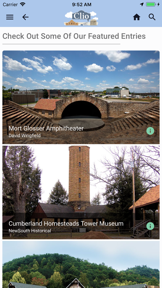
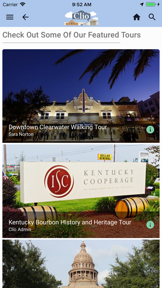
Clio is a location-based history discovery app for travelers and students, featuring walking tours and historical markers on iOS and Android.
The App DNA
What makes this app unique?
Users hire Clio to transform passive travel into active historical learning, using crowdsourced entries to find context where traditional guidebooks fail.
For History enthusiasts, travelers, and educational institutions seeking to document and explore local cultural heritage.
What does it look like?
Key features
Triggers push notifications for historical landmarks based on a user-defined radius from 10 to 5000 meters
Allows institutions, universities, and local experts to publish and vet historical entries and walking tours
Curated, location-based walking and driving tours with audio, video, and 360-degree imagery
How much does it cost?
Non-profit model sustained by tax-deductible donations and paid consulting services rather than subscription tiers.
Velocity
Maintenance developmentUX improvementsperformanceShow more...
The app currently ships at a cadence of approximately 0.04 releases per week, which falls into the maintenance tier. Development activity is sparse, with the last two releases occurring five months apart across different platforms. The release notes are generic and focus on minor improvements rather than new features or live operations. There is no evidence of a recurring event cycle or active feature development.
Who built it?
User Sentiment
What do users think recently?
Fresh user feedback skews thrilled. Users appreciate location-based historical discovery features provide educational value for travelers and local history enthusiasts, but report application stability issues including frequent crashes prevent consistent access to historical content.
How are ratings & reviews evolving?
What users say, by theme
- Location-based historical discovery features provide educational value for travelers and local history enthusiasts
- Application stability issues including frequent crashes prevent consistent access to historical content
60 of 99 recent reviews analyzed · high confidence · Thrilled overall
Read the full review analysisUnlock 1 user request, each backed by review evidence.
Access the full report for freeCompetition
Competitive landscape for Clio - Your Guide to History
How's the Travel market?
Clio maintains a high 4.54 average rating across platforms, but its lack of commercial booking integration limits its grossing potential compared to travel-focused competitors.
Read the market outlookThe rivals identified

By National Park Service
The NPS app dominates the historical and outdoor exploration niche with massive scale and official, authoritative content that directly overlaps with Clio's mission.
- Official government-backed content ensures high-fidelity historical data that crowdsourced platforms struggle to match consistently
- Deep integration with physical park infrastructure provides offline maps and real-time alerts for site visitors
- Unified digital passport system gamifies the experience of visiting multiple historical and natural landmarks
 Inquire — Wikipedia Around YouContender
 Viator Tours & AttractionsContender
 GetYourGuide: Plan & BookContender
Unlock the head-to-head verdict: where this rival wins, and where it loses.
Access the full report for freeThe Analyst's Read
Key takeaways for Clio - Your Guide to History
Where is it heading?
The historical discovery market is consolidating around authoritative, high-fidelity content, placing pressure on crowdsourced platforms to maintain quality. Clio remains advantaged by its institutional partnerships, but technical instability risks ceding ground to more stable, government-backed alternatives.
- Frequent application crashes in the current version erode the daily active habit, which compounds the rating drag already visible on Android.
- Institutional partnerships continue to drive crowdsourced content acquisition, reducing operational costs for the foundation and expanding the total addressable database.
The SWOT
- Institutional partnership model functions as a B2B distribution moat into academic history departments
- Geofencing triggers drive session frequency during travel-based discovery
- International expansion into Canada addresses current user requests
- Wearable integration could provide hands-free discovery during walking tours
Next best moves
Audit crash logs to stabilize the app because frequent crashes are the top complaint → improve retention
+ 1 more prioritized moveThe counter-intuitive read
The app's non-profit status is a competitive advantage, not a weakness…
Read the full takeFeature gaps
Offline maps (available in National Park Service app but missing here) +1
Since the last report: The platform has transitioned into a maintenance-heavy state characterized by technical instability and a declining user rating, despite the addition of geofencing capabilities.
Bottom line
Clio holds a unique niche in educational history discovery, but technical instability threatens its long-term retention, so the PM must prioritize stability over new feature expansion to protect the user base.
Unlock 2 critical frictions, 2 market threats, 1 more prioritized move and the analyst’s take.
Access the full report for freeReport last updated