


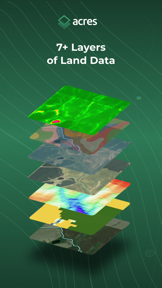


Acres is a land-mapping and parcel-analysis tool for real estate professionals and landowners, available on iOS and Android.
The App DNA
What makes this app unique?
The app removes the friction of switching between desktop-based property research and on-site physical verification by syncing custom maps and waypoints.
For Landowners, real estate professionals, developers, and investors requiring parcel-level data and field mapping tools.
What does it look like?
Key features
Displays property owner names for specific parcels; acts as a premium-tier gate for professional users.
Provides soil, crop, and flood risk data; serves as a B2B hook for enterprise due diligence.
Downloads satellite-view areas for remote use; serves as a critical retention lever for field-based users.
How much does it cost?
The freemium model gates high-value identity data behind a subscription to drive paid conversion among professionals.
Velocity
Maintenance developmentplatform expansionUX improvementsperformanceShow more...
Acres has transitioned to a maintenance cadence, with 9 releases over the observed window and a current update frequency of approximately one release every 1.5 months. While the latest release introduced tablet support and landscape views, the overall development trend has decelerated compared to the previous year. The app previously focused on feature expansion, including layer folders and coordinate search, but recent activity is primarily focused on stability and minor platform refinements. The app has not seen a release in 113 days.
Who built it?
User Sentiment
What do users think recently?
Recent user voice shows an excited sentiment. Users appreciate property boundary and land use visualization tools provide high utility for prospective land buyers and owners and the interface allows users to easily sync mapping data between web-based software and mobile devices.
How are ratings & reviews evolving?
What users say, by theme
- Property boundary and land use visualization tools provide high utility for prospective land buyers and owners
- The interface allows users to easily sync mapping data between web-based software and mobile devices
- The latest update adds tablet support and landscape view which improves the experience on larger screens
- Inaccurate public land data leads to property disputes and confrontations for private landowners
49 of 49 recent reviews analyzed · high confidence · Excited overall
Read the full review analysisUnlock 2 more frustration themes and 1 user request, each backed by review evidence.
Access the full report for freeCompetition
Competitive landscape for Acres: Land Data & Parcel Maps
How's the Business market?
Acres currently holds the #40 Grossing position in the US Business category. The gap between its free-tier utility and premium-gated ownership data creates a clear conversion funnel for professional investors.
The rivals identified

By onXmaps, Inc.
Dominates the land-mapping niche with massive scale and a specialized feature set that directly overlaps with Acres' core value proposition.
- Provides comprehensive public and private land ownership data layers that serve as the industry benchmark for hunters.
- Integrates advanced offline map caching and custom waypoint management specifically tailored for remote, off-grid navigation.
- Maintains a high-velocity release cadence with 11 updates in six months, ensuring constant feature refinement and stability.



Unlock the head-to-head verdict: where this rival wins, and where it loses.
Access the full report for freeThe Analyst's Read
Key takeaways for Acres: Land Data & Parcel Maps
Where is it heading?
The land-mapping market is consolidating around specialized utility, with onX Hunt setting the pace for offline reliability. Acres remains advantaged in the real estate research niche, but must resolve its authentication and data-accuracy friction to prevent professional users from migrating to more stable alternatives.
- Inaccurate public land data leads to property disputes, which erodes trust and increases churn among private landowners.
- Recent tablet support and landscape view updates demonstrate active feature investment, which helps maintain parity with professional-grade desktop workflows.
The SWOT
- Cross-platform sync increases switching costs for professional users
- Parcel-level research layers serve as B2B distribution barrier
- Ad-supported tier could capture casual user segment
- Transparent data-correction flow would mitigate reputational risk
Next best moves
Ship offline-first authentication because login friction is a top-reported barrier in remote areas → increase field-user retention
+ 1 more prioritized moveThe counter-intuitive read
The app's data accuracy issues are a retention opportunity: a transparent…
Read the full takeFeature gaps
Community-driven waypoint and trail condition sharing (available in onX Hunt but missing here)
Since the last report: Development velocity has decelerated into a maintenance-mode cadence, with no updates in 113 days, while the product strategy has pivoted to prioritize fixing core authentication and data-accuracy friction.
Bottom line
Acres must prioritize offline authentication and data-correction transparency to protect its professional user base, as these technical hurdles currently outweigh the value of its research layers.
Unlock 2 critical frictions, 2 market threats, 1 more prioritized move and the analyst’s take.
Access the full report for freeFAQ
Is Acres suitable for professional real estate research?
How does Acres compare to onX Hunt?
Does Acres work in remote areas without internet?
What are some alternatives to Acres for land mapping?
Sources
Report last updated