


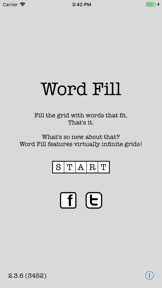


Word Fill is a paid puzzle game for iOS that provides infinite, procedurally generated fill-in puzzles for casual players.
Product velocity
Maintenance
Daily rank 🇺🇸
#55
▲6Games · paid
Sentiment
4.6
40 reviews
Nemesis

CodyCross: Crossword Puzzles
The App DNA
What makes this app unique?
Users hire Word Fill to replace physical puzzle books with a portable, offline-accessible experience that removes the time-pressure of traditional crosswords.
For Casual puzzle players seeking a relaxing, non-timed alternative to traditional crosswords for family-friendly entertainment.
What does it look like?
Key features
Procedural generation of fill-in puzzles that never repeat, accessible via the main game loop.
Word lists available in 16 languages, including English, Italian, Spanish, and French interface options.
Alternative puzzle format using numbers instead of words, available as an in-app purchase.
Full game functionality available without an active internet connection.
How much does it cost?
Paid model at $2.99 removes the need for recurring subscriptions or bonus pack microtransactions.
Velocity
Maintenance developmentperformanceopaqueShow more...
The app exhibits a maintenance-level cadence, with only two releases occurring in the last 17 months. The latest release occurred in January 2026, following a significant gap of over a year since the previous update in January 2025. Development is strictly limited to minor bug fixes and compatibility updates, with no evidence of new features or live operations. The long intervals between releases suggest a low-priority maintenance cycle.
Who built it?

User Sentiment
What do users think recently?
Fresh user feedback skews excited. Users appreciate the core word fill-in puzzle mechanic provides an addictive and challenging experience for long-term users and convenient mobile access to traditional puzzle book content replaces the need for physical paper and pencils.
How are ratings & reviews evolving?
What users say, by theme
- The core word fill-in puzzle mechanic provides an addictive and challenging experience for long-term users
- Convenient mobile access to traditional puzzle book content replaces the need for physical paper and pencils
- Lack of starting letter clues or word lists makes the puzzle difficulty feel arbitrary and frustrating
49 of 49 recent reviews analyzed · high confidence · Excited overall
Read the full review analysisUnlock 1 more frustration theme and 1 user request, each backed by review evidence.
Access the full report for freeCompetition
Competitive landscape for Word Fill - Fill in puzzles
How's the Games market?
Word Fill holds a #17 category rank in Italy and #26 in Australia, but the $2.99 price point limits its reach against free-to-play rivals. The gap between its paid model and the ad-supported market standard creates a persistent barrier to new user acquisition.
Read the market outlookThe rivals identified
By Fanatee
Dominates the word-puzzle category with a massive user base and high-frequency content updates.
- Integrates narrative-driven puzzle progression that transforms standard crossword mechanics into a thematic journey.
- Maintains a high-velocity content pipeline with 8 major releases in the last six months.
Unlock the deeper market read.
Access the full report for freeThe Analyst's Read
Key takeaways for Word Fill - Fill in puzzles
Where is it heading?
The casual puzzle market is consolidating around high-velocity, ad-supported titles that offer more frequent content updates. Word Fill's static, paid-only model leaves it exposed to churn, so revenue growth hinges on improving the first-session experience to justify the $2.99 barrier.
- The lack of logical hints in the current build forces guessing, which erodes the satisfaction of logical puzzle completion.
- Recent updates focused on stability, no feature expansion, signaling a maintenance-mode posture that leaves the app vulnerable to rivals.
The SWOT
- Infinite procedural grid generation sustains engagement without manual content updates
- Offline-first architecture eliminates dependency on server-side connectivity
- Implementing a hint system could reduce the arbitrary difficulty complaints
- Dark mode and font customization would improve accessibility for the core senior demographic
Next best moves
Ship a hint system because the lack of starting clues is the top complaint → reduce churn
+ 1 more prioritized moveThe counter-intuitive read
The infinite grid engine is a liability, not a strength…
Read the full takeFeature gaps
Narrative-driven progression (available in CodyCross but missing here) +1
Since the last report: The app has transitioned into a maintenance-mode lifecycle, with user sentiment declining due to a static feature set and pricing that fails to compete with free-to-play alternatives.
Bottom line
Word Fill defends its niche through infinite content, but the lack of logical hints and a high entry price drive churn, so the PM should prioritize a hint system to stabilize the user experience.
Unlock 2 critical frictions, 2 market threats, 1 more prioritized move and the analyst’s take.
Access the full report for freeReport last updated