
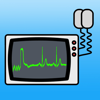


ECG and ACLS Tutor is a medical training app for rhythm identification and cardiac arrest simulation on iOS and Android.
The App DNA
What makes this app unique?
Users hire the app to rehearse high-stakes resuscitation skills in a low-cost, portable format that mimics real-world clinical monitors.
For Healthcare professionals and students preparing for American Heart Association Advanced Cardiac Life Support certification.
What does it look like?
Key features
Four-module training system covering rhythm identification, wave analysis, and interval measurement using dynamic screen-sweeping waveforms.
Screen-based simulation of cardiac arrest scenarios requiring patient evaluation, rhythm diagnosis, and team leadership.
Simulation logic updated to reflect 2024 American Heart Association treatment protocols for cardiac resuscitation.
How much does it cost?
Low-friction, one-time purchase model anchored at $0.99 to maximize volume among medical students and trainees.
Velocity
Steady developmentShow more...
Who built it?
User Sentiment
What do users think recently?
How are ratings & reviews evolving?
Not enough recent reviews to extract reliable themes yet.
Read the full review analysisCompetition
Competitive landscape for ECG and ACLS Tutor
How's the Medical market?
The app holds a #24 Medical category rank in the US, but the lack of Android ratings indicates a significant platform-specific discovery failure. The $0.99 price point serves as a volume-capture mechanism, yet it creates a revenue ceiling that prevents investment in high-fidelity simulation features.
Read the market outlookThe rivals identified

By Full Code Medical Inc.
Both apps target medical students and professionals needing clinical simulation, but the rival captures higher-intent users through accredited CME credits and a vast case library. The rival's #7 Grossing position in the US Medical category creates a significant scale advantage over the source app.
- Full Code offers accredited CME credits for professional certification, while the source app focuses on rhythm identification.
- Full Code utilizes AI-powered patient conversations to simulate clinical assessment, whereas the source app relies on waveform simulations.
- Full Code provides a 200-plus peer-reviewed case library, while the source app centers on specific rhythm modules.
 ECG Academy | ECG Made EasyContender
 ECG for Doctors | EMT | AEMTContender
 ECG PlaybookContender
 Auscultation - Heart SoundsContender
 Cardiac NinjaContender
 Resuscitation SIMContender
Unlock the head-to-head verdict: where this rival wins, and where it loses.
Access the full report for freeThe Analyst's Read
Key takeaways for ECG and ACLS Tutor
Where is it heading?
The medical simulation market is consolidating around high-fidelity, subscription-based platforms that offer deeper clinical immersion than static rhythm tools. ECG and ACLS Tutor remains exposed to this shift, as its one-time purchase model provides insufficient capital to fund the transition toward interactive, multi-user simulation.
- The latest update aligns simulation logic with 2024 AHA guidelines, ensuring the app remains a compliant tool for certification prep.
- Zero Android ratings suggest a critical discovery failure, which prevents the app from competing for the broader mobile medical student market.
The SWOT
- 2024 AHA guideline compliance maintains category authority
- Dynamic waveform display provides clinical training advantage
- Low-friction $0.99 price point maximizes student volume
- Expansion into institutional B2B nursing school licensing
- Integration of wearable-based heart rate data
- Development of multi-user team simulation modes
Next best moves
Audit Android discovery funnel because zero ratings suggest a broken install path → recover Android user base
+ 1 more prioritized moveThe counter-intuitive read
The app's low $0.99 price is not a strength but a strategic trap…
Read the full takeFeature gaps
High-fidelity interactive virtual patient scenarios (available in Full Code Medical Simulation) +1
Since the last report: The app expanded its core functionality to include ACLS simulation and guideline compliance, but identified critical Android discovery failures and revenue limitations.
Bottom line
The app maintains clinical relevance through timely AHA guideline updates, but the lack of a recurring revenue model and Android visibility leaves it vulnerable to high-fidelity competitors, so the PM must prioritize institutional B2B licensing to escape the consumer price ceiling.
Unlock 3 critical frictions, 3 market threats, 1 more prioritized move and the analyst’s take.
Access the full report for freeReport last updated