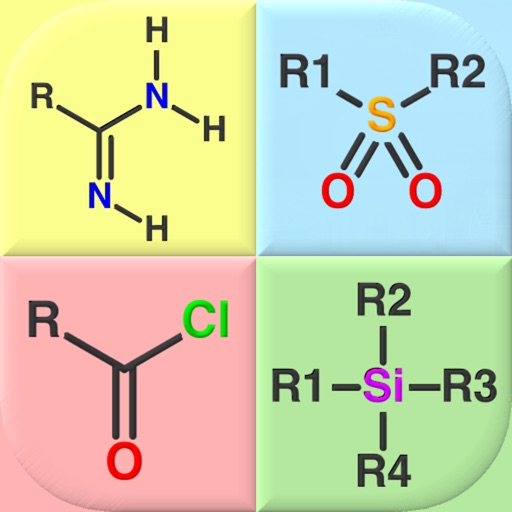


Functional Groups in Chemistry is a gamified study app for organic chemistry students, featuring quizzes and reference tables on iOS and Android.
The App DNA
What makes this app unique?
Students hire the app to memorize complex chemical structures through gamified repetition, replacing the social cost of manual flashcard creation.
For Organic chemistry and biochemistry students preparing for academic exams.
What does it look like?
Key features
Includes spelling, multiple-choice, time-based, and drag-and-drop formats.
Dedicated study tools for memorizing chemical structures.
Content translated into 15 languages.
One-time purchase to disable advertisements.
How much does it cost?
Freemium model anchored by a low-cost $0.99 IAP to remove ads, prioritizing high-volume ad-inventory from a global student user base.
Velocity
Dormant developmentnew contentUX improvementsShow more...
The development cadence is effectively dormant, with no releases recorded in the last six months. The most recent update occurred in November 2025, and prior to that, the app had not seen a release since early 2018. Given the lack of activity over an extended period, the app is classified as a zombie project. There is no evidence of ongoing maintenance or live operations.
Who built it?
Andrey Solovyev
13+ apps tracked · Games
 Inorganic Acids, Ions & Salts
 National Parks of the US: Quiz
 Country Days Tracker
 Famous Composers of Classical Music: Portrait Quiz
 50 US States - American Quiz
 Flags of All World Countries
 Maps of All Countries Geo-Quiz
 US Presidents and History Quiz
 Elements & Periodic Table Quiz
 Capitals of the World - Quiz
 Chemical Substances: Chem-Quiz
 European Countries - Maps Quiz
User Sentiment
What do users think recently?
The recent review mood reads excited. Users appreciate gamified learning structure helps chemistry students memorize complex functional groups and chemical structures effectively, but report inconsistent ad-free experience on paid versions creates frustration regarding the value proposition for users.
How are ratings & reviews evolving?
What users say, by theme
- Gamified learning structure helps chemistry students memorize complex functional groups and chemical structures effectively
- Inconsistent ad-free experience on paid versions creates frustration regarding the value proposition for users
56 of 56 recent reviews analyzed · high confidence · Excited overall
Read the full review analysisUnlock 1 user request, each backed by review evidence.
Access the full report for freeCompetition
Competitive landscape for Functional Groups in Chemistry
How's the Games market?
The app maintains a presence in the Education category across multiple international markets, with notable chart positions in Latin America and Europe. The grossing rank lagging behind free chart positions signals monetization friction relative to its discovery advantage.
Read the market outlookThe rivals identified

By Magoosh
Both apps compete for student study time by providing memorization tools for science-based academic exams, forcing a choice between gamified quizzes and spaced-repetition flashcards.
- Functional Groups in Chemistry uses a gamified quiz engine; MCAT Prep relies on static flashcard decks.
- Functional Groups in Chemistry supports 15 languages; MCAT Prep is limited to English-centric medical content.
- MCAT Prep implements a spaced repetition algorithm; Functional Groups in Chemistry lacks this retention mechanism.
- MCAT Prep provides full offline access; Functional Groups in Chemistry requires connectivity for ad-supported content.
 Chemistry FormulaContender
 Chemistry Answers-AP ChemistryContender
 Organic GamesContender
 Organic Chemistry ChallengeContender
 A Level Chemistry QuizContender
 Chemical Formulas QuizContender
 Chemistry Quiz (new)Contender
 Periodic Table Chemistry QuizContender

Unlock the head-to-head verdict: where this rival wins, and where it loses.
Access the full report for freeThe Analyst's Read
Key takeaways for Functional Groups in Chemistry
Where is it heading?
The organic chemistry study market is consolidating around tools that offer either deep pedagogical logic or community-driven content. Functional Groups in Chemistry remains exposed to these larger rivals, so its stability depends on fixing core monetization bugs and adding the requested category-filtering to retain students.
- Recent feature additions like drag-and-drop modes indicate active development rather than maintenance-mode status.
- Persistent reports of ads in paid versions erode trust, which will likely increase refund requests and lower long-term LTV.
The SWOT
- Gamified quiz engine drives repeat session frequency
- 15-language localization captures non-English academic markets
- Unobtrusive ad placement maintains high user satisfaction
- Implement custom category selection for exam focus
- Add spaced-repetition logic to compete with Anki
- Expand into wearable study-reminders
Next best moves
Audit ad-removal IAP logic because users report ads persist after payment → reduce refund surge
+ 1 more prioritized moveThe counter-intuitive read
The app's 15-language support is a B2B distribution moat for international academic partnerships…
Read the full takeFeature gaps
Spaced-repetition algorithm (available in AnkiMobile) +1
Since the last report: The app experienced a significant decline in user rating and increased friction regarding paid ad-removal, despite the introduction of new game modes.
Bottom line
The app succeeds as a gamified memorization tool, but inconsistent IAP performance and lack of category filtering limit its utility for serious exam prep. The PM should prioritize fixing the IAP logic to protect the revenue funnel before expanding study features.
Unlock 3 critical frictions, 3 market threats, 1 more prioritized move and the analyst’s take.
Access the full report for freeReport last updated