


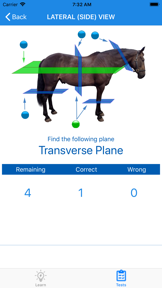

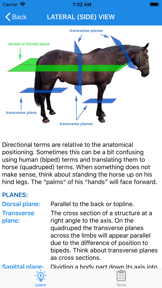
Equine Anatomy Learning Aid is a specialized educational app for equine bodywork students that provides interactive flashcards, labeling exercises, and anatomical quizzes on iOS and Android.
The App DNA
What makes this app unique?
Students use the app to replace static textbook study with active recall testing, removing the friction of manual flashcard creation for complex veterinary terminology.
For Students and practitioners of equine bodywork, veterinary medicine, and animal sports therapy.
What does it look like?
Key features
Customizable flash cards for origin, insertion, function, and innervation testing.
Interactive labeling of muscle plates and skeletal illustrations.
Assessment tool using illustrations and photographs to test anatomical knowledge.
How much does it cost?
The $15.99 one-time purchase model positions the app as a supplementary resource for the Equinology® Institute curriculum rather than a standalone mass-market tool.
Velocity
Maintenance developmentperformanceopaqueShow more...
Development is currently in a maintenance state, with the latest release occurring 89 days ago. The app has shipped only three updates in the last 12 months, all of which contained generic, opaque release notes focused on stability and minor fixes. There is no evidence of new feature development or live operations, suggesting the publisher is prioritizing basic upkeep over product expansion. The current cadence of roughly one update every 3 months reflects a stable but low-velocity maintenance cycle.
Who built it?
User Sentiment
What do users think recently?
Fresh user feedback skews thrilled. Users appreciate equine anatomy learning is supported by clear visual references and repeatable testing features for students and accessible content structure allows users to jump between sections without mandatory linear progression requirements.
How are ratings & reviews evolving?
What users say, by theme
- Equine anatomy learning is supported by clear visual references and repeatable testing features for students
- Accessible content structure allows users to jump between sections without mandatory linear progression requirements
- Lack of a search function makes locating specific muscles or bones difficult for users
28 of 28 recent reviews analyzed · moderate confidence · Thrilled overall
Read the full review analysisUnlock 2 more frustration themes and 1 user request, each backed by review evidence.
Access the full report for freeCompetition
Competitive landscape for Equine Anatomy Learning Aid
How's the Book market?
The app currently holds a #34 position in the US Books & Reference category. Its $15.99 price point targets a narrow, professional-focused segment, contrasting with the broader, subscription-based professional atlases that dominate the veterinary space.
Read the market outlookThe rivals identified

By KareemTKB
Both apps compete for the same student demographic requiring portable anatomical reference materials, despite the difference in species-specific content focus.
- Equine Anatomy Learning Aid provides specialized flashcard-driven active recall; Human Anatomy and Physiology offers general reference material.
- Equine Anatomy Learning Aid requires a one-time purchase; Human Anatomy and Physiology operates on a free model.
 MBLEX EXAM PREP | 2026Contender
 3D Heart AnatomyContender
 Human Anatomy Quiz & AtlasContender
 Muscles & Kinesiology CardsContender
 body anatomy guideContender
Unlock the head-to-head verdict: where this rival wins, and where it loses.
Access the full report for freeThe Analyst's Read
Key takeaways for Equine Anatomy Learning Aid
Where is it heading?
The equine anatomy education market is consolidating around professional-grade, multi-species tools that offer high-frequency updates. Equine Anatomy Learning Aid remains stable within its niche, but its maintenance-only cadence risks long-term erosion as users migrate to platforms that offer broader anatomical coverage and better search capabilities.
- The maintenance-only release cadence (avg 195 days between updates) prevents the app from keeping pace with modern mobile OS standards.
- High satisfaction (4.8 stars) among the core equine bodywork student segment indicates strong product-market fit for the current feature set.
The SWOT
- Integrated flashcard functionality supports active recall for origin, insertion, and innervation.
- Non-linear content structure allows immediate access to specific anatomy sections.
- Expanding content to include gastrointestinal tract and organ anatomy addresses top user requests.
Next best moves
Ship keyword-based search functionality because users report frustration locating specific muscles → reduce refund requests
+ 1 more prioritized moveThe counter-intuitive read
The app's lack of a subscription model is its biggest risk…
Read the full takeFeature gaps
Multi-species anatomical database (available in IMAIOS vet-Anatomy but missing here) +1
Since the last report: Development velocity has transitioned from active to maintenance-only, with the average time between updates increasing from 71 to 195 days. This stagnation is compounded by new user complaints regarding mobile scaling and zoom limitations.
Bottom line
The app's specialized pedagogical value retains core students, but the lack of search and maintenance-mode cadence leaves it vulnerable to professional-grade rivals. Prioritizing core usability will protect the current user base while the team evaluates a transition to a recurring revenue model.
Unlock 2 critical frictions, 1 market threat, 1 more prioritized move and the analyst’s take.
Access the full report for freeFAQ
Is Equine Anatomy Learning Aid suitable for veterinary students?
How does this compare to IMAIOS vet-Anatomy?
Does the app have a search function?
Are there free alternatives for equine anatomy study?
Sources
- [1] App Store, source
Report last updated