


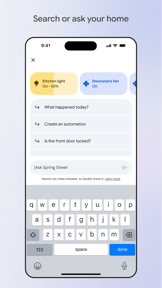

Google Home is a lifestyle app for managing Nest, Chromecast, and Matter-compatible devices on iOS and Android.
The App DNA
What makes this app unique?
Users hire the app for centralized control of their smart home hardware, aiming to reduce the friction of managing disparate devices through a single interface.
For Smart home owners using Google Nest, Chromecast, and Matter-compatible devices who seek centralized control.
What does it look like?
Key features
Natural language interface for device control and home management.
Connectivity standard for interoperability with third-party smart home devices.
Grouped control interface for managing smart home hardware settings.
How much does it cost?
The app serves as a free control surface to drive hardware sales and recurring Nest Aware subscription revenue.
Velocity
Active developmentopaqueperformanceShow more...
The app maintains a consistent release cadence of approximately 0.38 releases per week, or one update every 13-14 days. Despite this active development schedule, the publisher consistently uses identical, generic release notes across all recent versions, suggesting that updates may be driven by server-side feature flags or A/B testing rather than traditional App Store feature drops. The development trend is stable, though the lack of transparency in changelogs makes it impossible to identify specific feature milestones or content additions.
Who built it?
13+ apps tracked · Lifestyle
 Google Family Link
 Google Earth
 YouTube Kids
 Google TV: Watch Movies & TV
 Google Docs
 Photomath
 Gboard – the Google Keyboard
 Google One
 Google Keep - Notes and lists
 Google News
 Snapseed: Photo Editor
 Google NotebookLM
User Sentiment
What do users think recently?
The recent review mood reads mixed. Users appreciate centralized device management, but report high latency in device execution.
How are ratings & reviews evolving?
Weekly average review rating
What users say, by theme
- Centralized device management
Unlock 1 more frustration theme, each backed by review evidence.
Access the full report for freeCompetition
Competitive landscape for Google Home
How's the Lifestyle market?
Google Home holds the #11 Free rank in the US lifestyle category. The high volume of 4.9M total ratings across platforms underscores its role as the default control surface for the Google hardware portfolio.
Read the market outlookThe rivals identified

By Tuya Smart Inc.
Both apps compete for the same smart home user base by providing centralized control surfaces for connected hardware and automated routines. They overlap directly in their core utility of managing disparate smart devices within a single interface.
- Tuya supports legacy hardware connectivity, maintaining long-term retention for users with older smart home devices.
- Tuya provides automated routines for smart lighting and appliances, simplifying daily home management tasks.
 NestContender
 SmartThingsContender
 Amazon AlexaContender
 SmartHQContender
 IKEA Home smartContender
 YI HomeContender
 Crestron HomeContender
 FRITZ!App Smart HomeContender
Show 2 more


Unlock the head-to-head verdict: where this rival wins, and where it loses.
Access the full report for freeThe Analyst's Read
Key takeaways for Google Home
Where is it heading?
The smart home market is consolidating around responsive, local-first control interfaces, leaving cloud-heavy apps like Google Home exposed to churn. If the team does not address the Android dashboard latency, the current #11 chart position will compress as users migrate to lighter alternatives like Hubspace.
- Android dashboard instability in the latest release erodes the daily habit-loop, which compounds the rating drag already visible on the platform.
- Gemini for Home integration provides a unique natural language control surface that competitors currently lack, driving long-term retention.
The SWOT
- System-level Android integration replaces default assistant triggers
- Nest Aware subscription revenue model drives hardware ecosystem lock-in
- Unified dashboard groups disparate hardware into a single control surface
- Untapped education partnerships for B2B distribution
- Expansion of Matter-compatible device support
Next best moves
Audit Android dashboard execution path because latency is the top-reported frustration theme → reduce churn
The counter-intuitive read
The 'AI race' framing misses that Google's advantage is OS-level access…
Read the full takeFeature gaps
Local-first device control (available in Hubspace but missing here)
Since the last report: The competitive landscape has shifted to prioritize performance against lightweight rivals like Hubspace, while the product strategy has narrowed to focus on latency reduction.
Bottom line
Google Home defends its category lead through deep OS-level integration, but performance regressions on Android create an opening for lightweight rivals like Hubspace, so the PM must prioritize latency reduction to protect the core user base.
Unlock 3 critical frictions, 2 market threats and the analyst’s take.
Access the full report for freeSources
Report last updated