


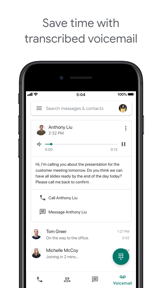

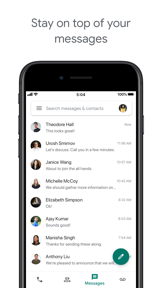
Google Voice is a cloud-based telephony service for personal and business users, providing phone numbers, messaging, and voicemail across iOS and Android.
The App DNA
What makes this app unique?
Users hire Google Voice to maintain a professional secondary line on existing hardware without the cost of a dedicated mobile carrier plan.
For Individuals and businesses requiring cloud-based telephony integrated with Google Workspace productivity tools.
What does it look like?
Key features
Automatic conversion of voicemail audio to text
Centralized interface for number assignment and billing
Connects third-party PSTN services to Google Voice
How much does it cost?
Tiered subscription model scales based on administrative control, reporting depth, and automation.
Velocity
Active developmentperformanceopaqueShow more...
Google Voice maintains an active release cadence, shipping 5 updates over the last 27 days, averaging approximately 1.3 releases per week. Despite this high frequency, all recent release notes are uniformly opaque, citing only stability and performance improvements without detailing specific feature changes. This pattern suggests the publisher may be utilizing server-side feature flags or A/B testing to manage updates rather than traditional App Store changelogs. The development trend remains stable, focused exclusively on maintenance and technical optimization.
Who built it?
13+ apps tracked · Productivity
 Google Family Link
 Google Earth
 YouTube Kids
 Google TV: Watch Movies & TV
 Google Docs
 Photomath
 Gboard – the Google Keyboard
 Google One
 Google Keep - Notes and lists
 Google News
 Snapseed: Photo Editor
 Google NotebookLM
User Sentiment
What do users think recently?
Recent user voice shows a mixed sentiment. Users appreciate reliable secondary phone number management keeps personal and business communications organized across multiple devices, but report mandatory identity verification requirements alienate users seeking anonymous or private communication channels.
How are ratings & reviews evolving?
What users say, by theme
- Reliable secondary phone number management keeps personal and business communications organized across multiple devices
- Mandatory identity verification requirements alienate users seeking anonymous or private communication channels
100 of 237 recent reviews analyzed · high confidence · Mixed overall
Read the full review analysisUnlock 1 user request, each backed by review evidence.
Access the full report for freeCompetition
Competitive landscape for Google Voice
How's the Productivity market?
Google Voice holds a #31 Free rank in the US Productivity category. The gap between its free entry point and the $30/user Premier tier creates a clear path for enterprise upsell, though it faces stiff competition from unified platforms like Zoom.
Read the market outlookThe rivals identified
By RingCentral, Inc.
The primary enterprise-grade rival that mirrors Google Voice's shift toward unified communications and Google Workspace-style business integrations.
- Advanced multi-level IVR and complex call routing configurations
- Native hardware support for a wide range of physical desk phones
- Superior real-time analytics and QoS (Quality of Service) reporting for IT admins
Unlock the head-to-head verdict: where this rival wins, and where it loses.
Access the full report for freeThe Analyst's Read
Key takeaways for Google Voice
Where is it heading?
The UCaaS market is consolidating around unified platforms that combine voice, video, and chat. Google Voice remains advantaged by its Workspace ecosystem, but the current reliability issues and feature stagnation leave it exposed to competitors like Zoom Phone, so the PM must stabilize the core messaging loop to prevent further churn.
- Message delivery failures in the latest version disrupt professional communication, which compounds the rating drag already visible on Android.
- Continued focus on Workspace integration ensures the app remains the default choice for existing Google business customers.
The SWOT
- Workspace integration provides frictionless deployment for existing Google users
- Cross-device sync increases daily utility
- Education sector partnerships remain untapped for B2B distribution
- Integration of RCS messaging standards would close the feature gap
Next best moves
Audit message delivery infrastructure because delivery failures are a top complaint → reduce churn
+ 1 more prioritized moveThe counter-intuitive read
The lack of RCS is not a feature…
Read the full takeFeature gaps
Real-time sentiment analysis (available in Dialpad) +1
Since the last report: Google Voice has pivoted from an aggressive enterprise expansion strategy to a defensive posture focused on core messaging reliability and maintaining its lightweight footprint.
Bottom line
Google Voice maintains its market lead through deep Workspace integration, but the degradation in message reliability and lack of RCS support threaten its professional utility, so the PM must prioritize infrastructure stability to retain business users.
Unlock 2 critical frictions, 2 market threats, 1 more prioritized move and the analyst’s take.
Access the full report for freeReport last updated