


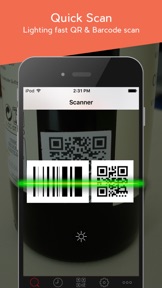


Barcode Scanner - QR Scanner is a utility app for Android and iOS that provides high-speed optical scanning and QR code generation for retail and industrial use.
The App DNA
What makes this app unique?
Users hire this app for instant, reliable data extraction from physical barcodes, replacing manual entry with a high-accuracy scanning engine.
For Industrial users and logistics professionals requiring high-accuracy barcode scanning, alongside casual users needing basic QR code generation.
What does it look like?
Key features
Reads over 30 barcode types including QR, UPC, GS1, Data Matrix, and DotCode via Android SDK
Extracts data from formatted barcodes like AAMVA driver licenses and IUID tags
Creates custom QR codes for contacts, URLs, locations, and calendar events
How much does it cost?
Freemium model gates full feature access behind a $2.99/month subscription while maintaining a free, ad-supported entry point.
Velocity
Dormant developmentperformanceShow more...
The app has been inactive for over 90 months, far exceeding the threshold for a zombie classification. The only recent activity is a single minor technical update in September 2025, which appears to be a isolated maintenance patch rather than a sign of ongoing development. There is no evidence of a consistent release cadence or active feature roadmap. The development status is considered dormant.
Who built it?
User Sentiment
What do users think recently?
Recent user voice shows an excited sentiment. Users appreciate high-speed scanning performance across diverse barcode and qr code formats and minimalist interface design free from intrusive advertisements or subscription prompts, but report inconsistent scanning reliability on specific barcode types or damaged surfaces.
How are ratings & reviews evolving?
What users say, by theme
- High-speed scanning performance across diverse barcode and QR code formats
- Minimalist interface design free from intrusive advertisements or subscription prompts
- Inconsistent scanning reliability on specific barcode types or damaged surfaces
60 of 100 recent reviews analyzed · high confidence · Excited overall
Read the full review analysisUnlock 1 more frustration theme and 1 user request, each backed by review evidence.
Access the full report for freeCompetition
Competitive landscape for Barcode Scanner - QR Scanner
How's the Shopping market?
The app holds a #40 Grossing position in the US Shopping category, though it shows stronger monetization in emerging markets like Uganda (#2 Grossing). The gap between its discovery-led free usage and grossing rank signals a need to better convert casual scanners into subscribers.
Read the market outlookThe rivals identified

By Kerem Erkan
Both apps compete for the utility scanning market, but Qrafter targets professional users with inventory management and encrypted generation while Barcode Scanner - QR Scanner prioritizes casual users through an ad-free experience.
- Qrafter includes AES-encrypted QR generation for secure data sharing, which is absent in the source app.
- Qrafter provides an inventory scanner mode with custom API triggers for professional warehouse workflows.
- Qrafter offers custom QR design tools, whereas the source app focuses on standard generation.
 QR Code Reader ·Contender
 QR Code Reader/QR Scanner AppContender
 Scan QR Code.Contender
 QR Code Reader: Quick ScanContender
 QR Code Reader,Barcode ScannerContender
 QR, Barcode Scanner for iPhoneContender
 QR Code & Barcode Scanner ・Contender
 QR Pro - Easy QR Code ScannerContender

Unlock the head-to-head verdict: where this rival wins, and where it loses.
Access the full report for freeThe Analyst's Read
Key takeaways for Barcode Scanner - QR Scanner
Where is it heading?
The barcode scanning market is consolidating around high-utility, multi-format tools, leaving single-purpose apps vulnerable to hardware-agnostic rivals. The app's stable performance provides a foundation, but it must evolve beyond camera-only input to avoid losing share to competitors like NFC Tools.
- High-speed scanning performance continues to drive positive sentiment, maintaining a strong baseline for user retention.
- The lack of image-upload functionality creates a persistent friction point that limits utility for non-camera device users.
The SWOT
- High-accuracy cmbSDK integration sustains industrial-grade scanning performance
- Minimalist UI design reduces churn compared to ad-heavy competitors
- Integrate image-based scanning to capture users on non-camera hardware
- Expand technical metadata display to satisfy power-user requests
Next best moves
Ship image-upload functionality because users on non-camera devices report it as a top friction point → increase addressable user base
+ 1 more prioritized moveThe counter-intuitive read
The app's #40 grossing rank in the US…
Read the full takeFeature gaps
NFC/RFID tag management (available in NFC Tools) +2
Since the last report: Users report: The app successfully pivoted from a deceptive, non-functional utility to a high-performance scanning tool, resulting in a positive sentiment shift despite a lack of active feature development.
Bottom line
The app maintains a strong category lead through high-speed scanning, but its reliance on camera-only input limits growth, so the PM should prioritize image-upload functionality to capture the non-camera user segment.
Unlock 2 critical frictions, 2 market threats, 1 more prioritized move and the analyst’s take.
Access the full report for freeReport last updated