Report updated Jun 3, 2026
NaturalReader - Text To Speech
For students, professionals, and individuals with reading difficulties or visual impairments.
NaturalReader - Text To Speech is a well-regarded productivity app that is free with in-app purchases. With a 4.4/5 rating from 64K reviews, it maintains solid user satisfaction. Users particularly appreciate natural-sounding voice synthesis provides high-quality audio output for students and dyslexic readers, though inconsistent voice behavior and unexpected accent switching disrupt the reading experience for long documents remains a common concern.
What is NaturalReader - Text To Speech?
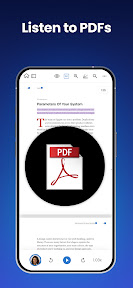
NaturalReader is a text-to-speech productivity app for students and professionals that converts PDFs, documents, and physical text into audio on iOS and Android.
Users hire NaturalReader to offload reading tasks during commutes or study sessions, using high-fidelity AI voices to improve comprehension for auditory learners and those with dyslexia.
Current Momentum
v9.40 · 4w ago
Intense- Fixed stability issues in latest release.
- Maintains steady update cadence.
Active Nemesis
Speechify – Text to Speech PDF
By Speechify
Other Rivals
7-Day Rank Pulse 🇺🇸
ProductivityNo ranking data
Rating Pulse 🇺🇸
Recent User Mood
What makes this app unique?
What Does It Look Like?
What Are The Key Features?
High-fidelity AI voices that mimic human intonation
OCR technology for physical text conversion
Custom fonts and visual highlighting
How much does it cost?
- Free tier
- Plus Subscription plan
Gates high-fidelity voices and offline MP3 exports behind a subscription.
Who Built It?
Portfolio
1
Apps
Explore the full NaturalSoft report
Portfolio breakdown, audience, momentum, and every app published by NaturalSoft.
What do users think recently?
High confidence · 49 reviews analyzed
How did the latest release land?
What is the recent mood?
Recent user voice shows a excited sentiment. Users appreciate natural-sounding voice synthesis provides high-quality audio output for students and dyslexic readers, but report inconsistent voice behavior and unexpected accent switching disrupt the reading experience for long documents.
Limited review volume (49 reviews). Sentiment analysis will deepen as more data lands.
View the full user-sentiment analysis
Mood gauge, ratings & review-volume history, every praise / complaint / request, and sentiment over time.
What is the competitive landscape for NaturalReader - Text To Speech?
Where is it available?
Localized markets (12)
How's The Productivity Market?
NaturalReader targets students and accessibility-focused professionals, utilizing a freemium model to drive acquisition. The app currently holds the #69 Grossing position in the US Productivity category, though its grossing rank frequently lags behind its free-tier discovery, signaling friction in converting casual listeners into paid subscribers.
How does it evolve in the Productivity market?
NaturalReader sits #69 Grossing in US Productivity, but its grossing rank lags behind its discovery, signaling conversion friction at the current subscription price point.
Rank progression
117 active rankings tracked — 30-day window
The rivals identified
Nemeses(1)
Dominates the text-to-speech productivity niche with massive scale and a high-velocity release cadence of 20 updates in six months.
Differentiators
- Aggressive cross-platform synchronization allows seamless transitions between mobile, desktop, and browser-based reading sessions.
- Advanced OCR technology enables high-fidelity text extraction from physical books and complex document layouts.
- Premium voice library features celebrity-grade neural synthesis that significantly outperforms standard TTS engine quality.
Head to head
Target must pivot toward niche document-handling efficiency or superior UX simplicity to avoid being crushed by Speechify's feature-rich, high-velocity ecosystem.
Contenders(1)
A direct productivity-focused competitor that maintains a steady release cadence and serves the same core text-to-speech utility.
Differentiators
- Provides granular control over playback speed and voice pitch, catering to power users and accessibility-focused demographics.
- Optimized for large document libraries, allowing users to manage extensive reading lists more effectively than standard readers.
Same space(3)
Targets the 'read-it-later' audience, overlapping with the target app's utility for consuming web articles as audio.
Differentiators
- Focuses on a clean, distraction-free reading environment that prioritizes text clarity over multi-format document support.
- Employs a 'save-for-later' workflow that encourages users to curate content before converting it to audio.
Dominates the audio consumption space, capturing the same user intent for 'listening' even if the content source differs.
Differentiators
- Provides a curated, high-production-value content library that shifts the user experience from utility to entertainment.
- Features a robust, mature playback engine with advanced bookmarking, sleep timers, and cross-device progress synchronization.
A massive ecosystem player that includes native 'Read Aloud' capabilities, threatening standalone TTS apps through platform ubiquity.
Differentiators
- Integrates text-to-speech directly into the browsing experience, eliminating the need for separate document import workflows.
- Leverages Microsoft's proprietary Azure neural voices, providing industry-leading audio quality without requiring a dedicated third-party app.
New entrants(2)
An emerging niche player that recently updated, focusing on the unique intersection of real-time data and audio synthesis.
Differentiators
- Transforms live data streams into ambient audio, offering a novel, non-traditional take on text-to-speech technology.
- Targets a specific, data-curious audience rather than the general-purpose document reading market.
Demonstrates high development activity with 25 releases in the last six months, signaling a rapid attempt to capture market share.
Differentiators
- Prioritizes a minimalist, zero-friction interface designed to get users from text to audio in fewer taps.
- Focuses on rapid iteration cycles to address specific user-reported bugs and feature requests in real-time.
Compare NaturalReader - Text To Speech against every rival
All rivals in one side-by-side table — identity, store metrics, ratings & sentiment, and strategic intel — plus a head-to-head page for each.
The outtake for NaturalReader - Text To Speech
Strengths to defend, gaps to attack
Core Strengths
- Accessibility-first design builds category authority
- OCR-to-audio pipeline drives academic retention
- 1000+ voice library offers deep customization
Critical Frictions
- Annual subscription cost exceeds category median
- Voice-accent switching disrupts long-form reading
- Technical instability persists post-update
Growth Levers
- Expand B2B partnerships with educational institutions
- Integrate wearable-device support for commuters
Market Threats
- Microsoft Edge native integration removes standalone need
- Speechify release cadence outpaces current development
What are the next best moves?
Audit voice-synthesis engine because accent-switching complaints disrupt long-form reading → improve retention
Accent-switching is a top-cited complaint in recent reviews.
Trade-off: Delay the planned UI refresh for the library view — stability is the primary churn risk.
Introduce a lower-cost, feature-limited subscription tier because annual pricing is a top-cited friction point → increase conversion
User sentiment highlights high annual costs as a barrier for casual users.
Trade-off: Pause the development of new voice-cloning features — current conversion friction is a higher revenue risk.
A counter-intuitive read
The app's #69 grossing rank is a hidden strength: maintenance-mode at this scale is more resilient to churn than a high-velocity, high-burn competitor like Speechify.
Feature Gaps vs Competitors
- Real-time cross-platform sync (available in Speechify but missing here)
Key Takeaways
- Prioritize stability and voice-consistency fixes to protect the core student user base from churn.
- Evaluate a lower-cost, feature-limited subscription tier to capture price-sensitive casual users currently lost to the paywall.
- Monitor Microsoft Edge's native TTS adoption as a long-term threat to standalone productivity utility.
NaturalReader maintains a strong category lead through accessibility-focused utility, but inconsistent voice synthesis and high subscription costs threaten its retention, so the team must prioritize stability and pricing flexibility to defend against low-cost rivals.
Where Is It Heading?
Mixed Signals
The productivity-audio market is consolidating around native platform tools like Microsoft Edge, which threatens standalone apps. NaturalReader must transition from a general utility to a specialized academic tool to survive, so the PM should prioritize the OCR-to-audio workflow over general feature expansion.
Inconsistent voice-accent switching during long documents erodes the core utility, leading to increased churn among academic power users.
The OCR camera scanner remains a high-value differentiator for students, sustaining organic acquisition despite the subscription paywall.