


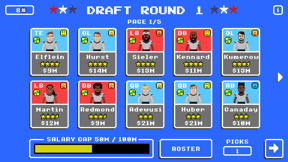
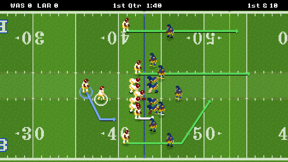


Retro Bowl is a retro-styled arcade football game with franchise management features for casual sports fans on iOS and Android.
The App DNA
What makes this app unique?
The app removes the cognitive and hardware costs associated with high-fidelity sports simulations, allowing users to play offline without the pressure of live-service content cycles.
For Casual sports fans and gamers who prefer retro-styled, accessible simulation games over complex, high-fidelity sports titles.
What does it look like?
Key features
Roster management and team development simulation including press duties and player ego management.
Simplified football mechanics focused on play-calling and on-field execution.
Community-driven challenges and leaderboard integration for competitive play.
How much does it cost?
The freemium model relies on high-volume engagement with optional in-app purchases to support ongoing development.
Velocity
Maintenance developmentperformancenew contentShow more...
Retro Bowl currently ships at a maintenance cadence, with 9 releases over the observed window and a last update 93 days ago. Development is primarily focused on minor stability improvements, controller input fixes, and periodic team strength updates to align with seasonal sports cycles. There is no evidence of a shift toward live-ops or high-frequency feature development, as the release cycle remains infrequent and reactive to technical issues.
Who built it?
New Star Games
7 apps tracked · Games
 Retro Bowl College
 Retro Goal
 New Star Soccer
 New Star GP
 Retro Slam Tennis
 New Star Cricket
User Sentiment
What do users think recently?
Review voice lately leans excited. Users appreciate retro-style football mechanics provide a simple yet addictive gameplay loop that remains engaging for years and offline play capability allows users to enjoy the game during travel or without a stable connection, but report aggressive interception logic and defensive ai behavior make high-difficulty matches feel unfair or scripted to users.
How are ratings & reviews evolving?
What users say, by theme
- Retro-style football mechanics provide a simple yet addictive gameplay loop that remains engaging for years
- Offline play capability allows users to enjoy the game during travel or without a stable connection
- Drafting and team-building depth provides enough strategic variety to keep career modes feeling fresh over time
- Aggressive interception logic and defensive AI behavior make high-difficulty matches feel unfair or scripted to users
72 of 149 recent reviews analyzed · high confidence · Excited overall
Read the full review analysisUnlock 2 more frustration themes and 2 user requests, each backed by review evidence.
Access the full report for freeCompetition
Competitive landscape for Retro Bowl
How's the Games market?
Retro Bowl maintains a consistent presence in the sports gaming category, with a 4.8-star rating across over 1.4 million total ratings. The lack of major feature updates in the latest release contrasts with the high-frequency live-service cadence of simulation rivals, signaling a shift toward maintenance-mode positioning.
Read the market outlookThe rivals identified

By FunCraft Games
17-0 Football Manager targets the same American football management audience as Retro Bowl, specifically competing for users interested in roster construction and franchise-building mechanics.
- 17-0 Football Manager allows drafting players across six decades of history, whereas Retro Bowl focuses on current franchise management.
- 17-0 Football Manager emphasizes online draft competition against real managers, while Retro Bowl prioritizes offline-first single-player career modes.
Unlock the head-to-head verdict: where this rival wins, and where it loses.
Access the full report for freeThe Analyst's Read
Key takeaways for Retro Bowl
Where is it heading?
The sports gaming market is consolidating around high-fidelity live-service titles, leaving Retro Bowl's retro-arcade niche as a stable but vulnerable alternative. The app's future depends on resolving technical friction points like cloud-save, which currently limit the lifetime value of its most loyal players.
- The lack of cloud-save functionality prevents progress transfer, which drives churn among the most invested power users who switch hardware.
- The core arcade-style gameplay loop continues to drive high engagement, maintaining a strong 4.8-star rating across a massive user base.
The SWOT
- Franchise management simulation increases session length and long-term player investment
- Offline-first design removes connectivity dependency required by simulation rivals
- Implementing direct defensive player control would increase strategic depth and satisfy top user requests
- Expanding team customization options could drive higher engagement in dynasty modes
Next best moves
Ship cloud-save functionality because it is the top-requested missing feature → unlock data-loss frustration
+ 1 more prioritized moveThe counter-intuitive read
The app's maintenance-mode cadence is a strategic advantage, not a weakness…
Read the full takeFeature gaps
Cloud-based progress syncing (available in most modern sports titles but missing here) +1
Since the last report: The app's strategic narrative shifted from viewing maintenance-mode as a liability to a deliberate competitive moat, while user feedback consolidated around defensive AI logic as a primary friction point.
Bottom line
Retro Bowl's retro-arcade niche remains a strong retention anchor, but the lack of cloud-save functionality creates a critical churn risk for power users. Prioritizing progress-sync infrastructure would secure the existing base against high-fidelity rivals without requiring a full feature-parity battle.
Unlock 2 critical frictions, 2 market threats, 1 more prioritized move and the analyst’s take.
Access the full report for freeFAQ
Is Retro Bowl worth playing if I am not a hardcore football fan?
How does Retro Bowl compare to Madden NFL 26 Mobile?
Does Retro Bowl require an internet connection to play?
What are some free alternatives to Retro Bowl?
Sources
- [1] App Store, source
Report last updated