


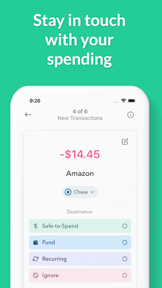

Weekly is a budget planner and spending tracker for individuals and couples, structured around a weekly spending limit on iOS.
The App DNA
What makes this app unique?
Users hire Weekly to manage variable income streams without the cognitive load of complex, zero-based budgeting systems.
For Individuals and couples seeking a simplified, weekly-focused approach to personal finance and debt management.
What does it look like?
Key features
Calculates a single daily or weekly spending allowance by subtracting recurring bills and savings goals from total income.
Connects to over 10,000 financial institutions to sync spending data automatically.
Shared access to budget data for partners to track household finances together.
How much does it cost?
Freemium model uses a subscription gate for premium features, anchored by a free tier that allows basic manual budgeting.
Velocity
Maintenance developmentperformanceopaqueShow more...
The app ships approximately 0.08 releases per week, placing it firmly in the maintenance tier. Development is characterized by infrequent, minor stability updates with no evidence of new features or live operations. The release notes are uniformly opaque, providing no insight into specific improvements or roadmap direction. The current cadence suggests a focus on minimal upkeep rather than active product growth.
Who built it?


User Sentiment
What do users think recently?
Fresh user feedback skews excited. Users appreciate weekly budget structure provides clarity for hourly employees and those with irregular income streams, but report feature removal in recent updates forces manual calculations and increases the number of required taps.
How are ratings & reviews evolving?
What users say, by theme
- Weekly budget structure provides clarity for hourly employees and those with irregular income streams
- Feature removal in recent updates forces manual calculations and increases the number of required taps
55 of 55 recent reviews analyzed · high confidence · Excited overall
Read the full review analysisUnlock 1 user request, each backed by review evidence.
Access the full report for freeCompetition
Competitive landscape for Weekly: Budget Planner App
How's the Finance market?
Weekly holds a #95 Grossing position in the US Finance category, with rank volatility (↑2) indicating that its simplified value proposition faces stiff competition from AI-first budget tools.
Read the market outlookThe rivals identified

By You Need A Budget LLC
YNAB is the dominant market leader in the zero-based budgeting niche, commanding a massive, highly loyal user base with a distinct methodology that directly competes with Weekly's philosophy.
- Enforces a strict zero-based budgeting methodology that forces users to assign every dollar a specific job
- Provides extensive educational resources and live workshops that create a high switching cost for committed users
- Offers robust multi-platform synchronization across web, mobile, and tablet that exceeds simple mobile-first budget trackers
 Goodbudget Budget PlannerContender
 Expense & Budget App: SpendeeContender
 PocketGuard・Budget Planner AppContender
Unlock the head-to-head verdict: where this rival wins, and where it loses.
Access the full report for freeThe Analyst's Read
Key takeaways for Weekly: Budget Planner App
Where is it heading?
The personal finance market is consolidating around AI-driven automation, leaving Weekly’s manual-heavy approach increasingly vulnerable. Unless the team restores automated templates and stabilizes bank sync, the app will continue to lose market share to competitors that reduce user effort.
- Feature regressions in the latest update increase manual input friction, which accelerates churn among long-term subscribers who expect automated workflows.
- Inconsistent bank connectivity leads to subscription cancellations, creating a direct revenue leak that outweighs the value of recent performance improvements.
The SWOT
- Weekly-first cadence reduces cognitive load for variable-income users
- Safe-to-Spend balance creates a high-frequency daily habit
- Untapped B2B partnerships with hourly-wage employers
- Wearable integration for persistent balance visibility
Next best moves
Restore automated fund templates because recent removals increase manual input friction → reduce churn among long-term subscribers
+ 1 more prioritized moveThe counter-intuitive read
Weekly’s manual-entry requirement is a feature, not a bug…
Read the full takeFeature gaps
Real-time chat for shared budgets (available in Honeydue) +1
Since the last report: The app has entered a maintenance phase characterized by feature regressions that increase manual input friction and rising user dissatisfaction regarding bank connectivity.
Bottom line
Weekly retains users through its unique weekly-first budgeting cadence, but feature regressions and bank-sync instability threaten long-term growth, so the PM must prioritize restoring automated templates and fixing connectivity to prevent churn.
Unlock 2 critical frictions, 2 market threats, 1 more prioritized move and the analyst’s take.
Access the full report for freeReport last updated