


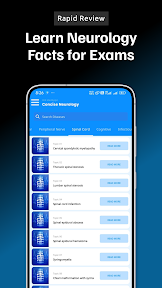


Concise Neurology is a clinical reference and exam preparation app for medical students and healthcare professionals on iOS and Android.
Product velocity
Maintenance
Daily rank 🇺🇸
#160
Medical · grossing
Sentiment
4.5
10 reviews
Nemesis

Star Gazer & Night Sky Map
The App DNA
What makes this app unique?
It removes the cognitive friction of synthesizing dense neurological textbooks into actionable clinical protocols for bedside learning and exam revision.
For Medical students, residents, doctors, and healthcare professionals.
What does it look like?
Key features
Real-world neurology scenarios for bedside learning and diagnostic practice.
Step-by-step instructions for cranial nerve, motor, sensory, and gait assessments.
Quick-reference guides for stroke, status epilepticus, and meningitis management.
How much does it cost?
Freemium model drives volume through a broad free-tier user base, with advanced diagnostic content gated to convert serious students and professionals.
Velocity
Maintenance developmentperformanceinternationalizationShow more...
The app maintains a maintenance-level cadence, with only two distinct versions released over the observed window and the latest release occurring 90 days ago. Development activity is limited to minor technical refinements, such as quiz load time optimization and localization adjustments, rather than new feature development. With an average of approximately 0.07 releases per week, the project shows no signs of active feature expansion or live operations. The current trajectory suggests a focus on stability rather than growth.
Who built it?
RER MedApps
13+ apps tracked · Medical
 Medical History Taking | OSCE
 ECG for Doctors | EMT | AEMT
 Concise Pediatrics Handbook
 Concise Surgery
 Anatomy 3D Atlas: Human Body
 Concise Medicine
 MedSimu - Cases
 Clinical Skills | OSCE Guide
 Concise Surgery Handbook
 Surgical Instruments Catalog
 Anatomy 3D Atlas | Human Body
 Surgical Principles | MRCS A
User Sentiment
What do users think recently?
How are ratings & reviews evolving?
Not enough recent reviews to extract reliable themes yet.
Read the full review analysisCompetition
Competitive landscape for Concise Neurology
How's the Medical market?
Concise Neurology currently holds a #17 Grossing position in the Medical category in India and #160 in the US, indicating successful monetization in emerging markets despite a limited review count of 10 on iOS.
Read the market outlookThe rivals identified
By Appelio
While in a different category, this app competes for the same 'educational reference' screen time and cognitive bandwidth of students and curious learners.
- Massive user base and community-driven content create a significant network effect moat for the developer.
- Real-time augmented reality sky mapping provides a high-engagement visual experience that static medical text lacks.
- Open-source community contributions ensure constant content updates without requiring heavy internal development resources.
 Universal Zoom - Science GuideContender
 HeartVisionContender
 Human Anatomy 3DContender
 Future EarthContender
Unlock the head-to-head verdict: where this rival wins, and where it loses.
Access the full report for freeThe Analyst's Read
Key takeaways for Concise Neurology
Where is it heading?
The medical reference market is consolidating around tools that offer institutional integration and dynamic, AI-assisted research capabilities. Concise Neurology remains exposed due to its static content library and lack of enterprise-ready distribution, which will likely lead to share erosion as competitors with faster update cadences capture the academic segment.
- The 90-day update gap indicates a maintenance-only posture, which leaves the app vulnerable to AI-driven competitors with faster research-aggregation cycles.
- Recent grossing chart entries in India and Italy suggest the freemium model is successfully capturing international student segments despite limited marketing.
The SWOT
- Structured clinical approach provides high-yield exam preparation
- Emergency protocols ensure daily reliance for healthcare professionals
- Localized pricing in high-ARPU markets could increase conversion
- Institutional partnerships would provide a defensible distribution moat
Next best moves
Ship institutional-grade access via Apple School Manager because it is the primary gap against rivals → unlock academic distribution
+ 1 more prioritized moveThe counter-intuitive read
The app's maintenance-mode release cadence is a strategic advantage…
Read the full takeFeature gaps
Apple School Manager integration (available in Universal Zoom but absent here) +1
Since the last report: Concise Neurology has pivoted its roadmap from 3D-model development to institutional-grade distribution via Apple School Manager integration. This shift addresses the app's lack of enterprise-ready channels, which currently limits its academic market penetration.
Bottom line
Concise Neurology must pivot toward institutional partnerships to secure its position against academic-focused rivals, as its current reliance on individual student downloads leaves it vulnerable to platforms with broader school-manager integration.
Unlock 2 critical frictions, 2 market threats, 1 more prioritized move and the analyst’s take.
Access the full report for freeSources
- [1] App Store, source
Report last updated