


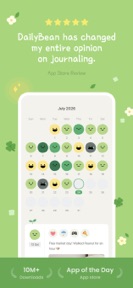


DailyBean is a visual, icon-based journal and mood tracker for iOS that replaces long-form writing with habit-logging modules.
The App DNA
What makes this app unique?
Users open the app to capture daily moments without the cognitive load of a blank page, using it as a low-friction mental health and habit repository.
For Individuals seeking a low-friction, visual method for mood tracking and habit logging without the burden of long-form writing.
What does it look like?
Key features
Visual icon-based system for recording daily habits and moods with minimal typing.
User-defined tracking modules for personalized habit monitoring.
Auto-syncs sleep, weather, and health metrics to populate logs.
How much does it cost?
Freemium model focused on high-frequency daily logging to build habituation, though recent price hikes have triggered user frustration.
Velocity
Intense developmentnew contentUX improvementsShow more...
DailyBean maintains an intense release cadence, averaging approximately 1.16 releases per week over the analyzed period. The development trend is stable and highly active, consistently delivering both functional improvements and UI refinements. Recent updates have focused on enhancing the journaling experience through new widgets, music integration, and improved layout aesthetics. The team demonstrates a clear commitment to iterative feature expansion rather than relying on opaque maintenance cycles.
Who built it?
BlueSignum
8 apps tracked · Lifestyle
 DailyBean: Simplest Journal
 Lime: Your Stress Strategist
 Moodee: To-dos for your mood
 Panora: Stress Watch, Heart
 Lighthouse : Self-care app
 Little Moodee
 Lime AI: Stress Strategist
User Sentiment
What do users think recently?
The recent review mood reads excited. Users appreciate minimalist aesthetic and intuitive mood logging interface make daily journaling feel rewarding and fast and integrated habit tracking features like sleep and step counting reduce the need for multiple apps, but report aggressive monetization and rising subscription costs frustrate long-term users who remember lower price points.
How are ratings & reviews evolving?
What users say, by theme
- Minimalist aesthetic and intuitive mood logging interface make daily journaling feel rewarding and fast
- Integrated habit tracking features like sleep and step counting reduce the need for multiple apps
- The free tier provides enough core functionality to maintain a consistent journaling habit without ads
- Aggressive monetization and rising subscription costs frustrate long-term users who remember lower price points
62 of 147 recent reviews analyzed · high confidence · Excited overall
Read the full review analysisUnlock 2 more frustration themes and 3 user requests, each backed by review evidence.
Access the full report for freeCompetition
Competitive landscape for DailyBean - simplest journal
How's the Lifestyle market?
DailyBean holds a strong position in the Lifestyle category, maintaining a 4.8-star rating across 70,258 reviews. The high review volume relative to its niche focus signals a deep habit loop, though the lack of a one-time purchase option limits conversion among college-aged users.
Read the market outlookThe rivals identified

By Apple
Both apps target the personal life logging segment with a focus on low-friction entry, but Apple Journal uses system-level data streams to automate entries while DailyBean relies on manual icon-based logging.
- Apple Journal automates entries using system-level data like photos and workouts, whereas DailyBean requires manual input.
- Apple Journal provides a completely free, ad-free experience, while DailyBean gates features behind a subscription model.
- DailyBean offers customizable category blocks for personalized data tracking, a feature absent in Apple Journal.
 Day One: Daily Journal & DiaryContender
 Daily Journal App - My DiaryContender
 My Diary - Mood Daily JournalContender
 My Diary - Journal with LockContender
 Simple Daily DiaryContender
 DAILY NOTE - Day Note, DiaryContender
Unlock the head-to-head verdict: where this rival wins, and where it loses.
Access the full report for freeThe Analyst's Read
Key takeaways for DailyBean - simplest journal
Where is it heading?
Users report: The lifestyle journaling market is consolidating around system-level tools, leaving DailyBean exposed if it cannot guarantee data reliability. The current focus on aesthetic updates will not offset the churn risk posed by recurring data-loss reports and subscription friction.
- Data loss reports following the latest update remain a top complaint, which directly undermines the app's core value as a memory repository.
- The intense 10-release cadence over 60 days demonstrates active feature investment, which keeps the interface competitive against static journaling rivals.
The SWOT
- Customizable category blocks increase switching costs
- Health data integration reduces multi-app dependency
- One-time purchase tier could capture churned users
- Gamified companion features could boost daily check-ins
Next best moves
Audit data-sync architecture because data loss reports remain the top churn driver → stabilize long-term retention
+ 1 more prioritized moveThe counter-intuitive read
The high subscription price is not just a monetization error…
Read the full takeFeature gaps
End-to-end encryption (available in Day One but missing here) +1
Since the last report: The competitive outlook has hardened, with the report now explicitly framing Apple Journal as a primary threat to the app's retention-focused model. While the feature set remains consistent, the analysis of the app's market position has pivoted to emphasize the failure to differentiate against free, system-level alternatives.
Bottom line
DailyBean’s visual habit loop is a defensible asset, but the current data-loss instability and aggressive subscription pricing are actively eroding the user base. Stabilizing the core record-keeping architecture is the only way to defend against system-level rivals like Apple Journal.
Unlock 2 critical frictions, 2 market threats, 1 more prioritized move and the analyst’s take.
Access the full report for freeSources
- [1] App Store, source
Report last updated