


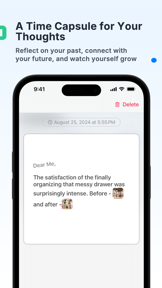


Dear Me - Letters To Self is a lifestyle journaling app for iOS that allows users to write and send time-delayed letters to their future selves.
The App DNA
What makes this app unique?
Users hire this app for a whimsical, low-friction time-capsule experience that prioritizes intentional reflection over the automated, data-heavy logging of native OS alternatives.
For Individuals interested in personal reflection, goal setting, and digital time-capsule journaling.
What does it look like?
Key features
Letters are held on-device and revealed after a randomized period of 30 to 90 days.
Letters are saved locally on the user device rather than a cloud server.
How much does it cost?
The app currently operates as a free utility with no visible monetization gates or subscription tiers.
Velocity
Dormant developmentopaqueShow more...
The app has not received a release in over 200 days, placing it firmly in the zombie category. The last available update was a minor release focused on basic bug fixes and saving functionality. There is no evidence of active development, live operations, or feature expansion. Given the lack of activity since December 2025, the development momentum is currently non-existent.
Who built it?
Beka Demuradze
5 apps tracked · Lifestyle
 Godot Planner
 Sea Service - Career Manager
 Spot It - Storage Organizer
 Slop Chest - Bonded Store
User Sentiment
What do users think recently?
Recent user voice shows a thrilled sentiment. Users appreciate minimalist design aesthetic allows users to maintain a consistent daily journaling habit without friction.
How are ratings & reviews evolving?
What users say, by theme
- Minimalist design aesthetic allows users to maintain a consistent daily journaling habit without friction
1 of 1 recent reviews analyzed · limited sample
Read the full review analysisCompetition
Competitive landscape for Dear Me - Letters To Self
How's the Lifestyle market?
Dear Me maintains a 4.81 rating across 16 reviews, positioning it as a high-satisfaction niche utility. Its lack of monetization and cloud-sync limits its scale compared to the native Apple Journal competitor.
Read the market outlookThe rivals identified

By Apple
As a native OS-level application, Journal directly competes for the same user base seeking to capture memories and thoughts, leveraging deep system integration that Dear Me cannot replicate.
- Native system-level integration provides automatic journaling suggestions based on photos, workouts, and location data.
- End-to-end encryption ensures user privacy at the hardware level, a standard Dear Me lacks.


Unlock the head-to-head verdict: where this rival wins, and where it loses.
Access the full report for freeThe Analyst's Read
Key takeaways for Dear Me - Letters To Self
Where is it heading?
The lifestyle journaling market is consolidating around automated, OS-integrated solutions that reduce user effort. Dear Me remains stable by serving a specific, intentional-reflection niche, but it must address its lack of persistence and security to avoid being marginalized by native competitors.
- The app maintains a high rating with a small user base, indicating strong product-market fit within its specific niche.
- Apple's native Journal app integration into the OS baseline creates a high-friction environment for manual-entry apps to acquire new users.
The SWOT
- Whimsical drag-and-drop interface creates a unique, tactile journaling experience.
- On-device storage functions as a privacy moat for users avoiding cloud-based journaling.
- Introduce premium cloud-sync tiers to capture power users.
- Add guided reflection prompts to increase daily session depth.
Next best moves
Ship biometric security because user reviews for rivals highlight security as a critical gap → improve trust.
+ 1 more prioritized moveThe counter-intuitive read
Users report: The app's lack of cloud-sync is…
Read the full takeFeature gaps
Biometric security (available in My thoughts - Cute diary but missing here) +2
Since the last report: The report shows a strategic shift toward addressing competitive feature gaps in security and persistence, moving away from a purely minimalist product focus.
Bottom line
Dear Me - Letters To Self offers a distinct, tactile journaling experience that avoids the clutter of automated apps, but the lack of cloud-sync and security features limits its long-term retention potential, so the PM should prioritize a secure, synced storage model to compete with native OS alternatives.
Unlock 2 critical frictions, 1 market threat, 1 more prioritized move and the analyst’s take.
Access the full report for freeSources
- [1] App Store, source
Report last updated