


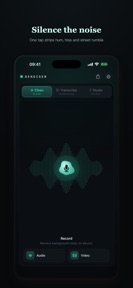


Denoiser is an on-device audio utility for iPhone that removes background noise, transcribes speech, and splits audio stems offline.
The App DNA
What makes this app unique?
The app removes the connectivity dependency required by cloud-based rivals, serving users who prioritize privacy and offline functionality.
For Content creators, journalists, and musicians requiring private, offline audio editing tools on iPhone.
What does it look like?
Key features
Removes background noise using DeepFilterNet locally. Revenue: Premium-tier gate restricts full-length processing.
Converts speech to text with word-level timestamps. Revenue: Premium-tier gate restricts full-length exports.
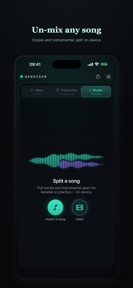
Separates audio tracks into individual stems. Revenue: Premium-tier gate restricts full-length stem exports.
How much does it cost?
The 30-second processing limit acts as a hard conversion gate for professional users.
Velocity
Maintenance developmentopaqueShow more...
The app is currently in its initial deployment phase with only one version released 20 days ago. Given the lack of subsequent activity, the development cadence is classified as maintenance. There is currently no evidence of a recurring update cycle or feature expansion beyond the initial launch build.
Who built it?

User Sentiment
What do users think recently?
How are ratings & reviews evolving?
Not enough recent reviews to extract reliable themes yet.
Read the full review analysisCompetition
Competitive landscape for Denoiser: AI Noise Remover
How's the Utilities market?
Denoiser occupies the privacy-focused utility segment, competing against cloud-dependent transcription tools. The absence of cloud-based account requirements creates a lower barrier to entry for privacy-conscious users compared to standard SaaS-based audio editors.
Read the market outlookThe rivals identified
Unlock the deeper market read.
Access the full report for freeThe Analyst's Read
Key takeaways for Denoiser: AI Noise Remover
Where is it heading?
The audio utility market is shifting toward on-device AI, where Denoiser is well-positioned due to its offline-first architecture. Sustaining this position requires moving beyond maintenance-mode to address the conversion friction in the free tier, which currently limits professional-user acquisition.
- The app remains in maintenance mode 21 days post-launch, signaling a focus on stability over rapid feature expansion.
The SWOT
- On-device processing removes the connectivity dependency rivals require
- Privacy-first design eliminates sign-in friction for casual users
- Localized pricing could capture high-ARPU markets where competitors rely on subscription-only models
Next best moves
Extend free-tier processing limit to 60 seconds because the 30-second gate is too restrictive for professional validation → increase conversion rate
The counter-intuitive read
The privacy-first, offline-only design is a retention lever…
Read the full takeSince the last report: The product strategy has shifted from passive maintenance to an active pivot, prioritizing the extension of the free-tier processing limit to address conversion friction. This change marks a move toward data-driven funnel optimization despite the lack of new feature releases.
Bottom line
Denoiser's privacy-first, offline architecture provides a defensible position for users in high-security environments, but the 30-second free-tier limit risks capping the funnel before users can validate the tool's utility for long-form content.
Unlock 1 critical friction, 1 market threat and the analyst’s take.
Access the full report for freeFAQ
Is Denoiser safe to use for sensitive recordings?
Does Denoiser require an internet connection?
How does Denoiser compare to cloud-based transcription apps?
Is there a free version available?
Sources
- [1] App Store, source
Report last updated