


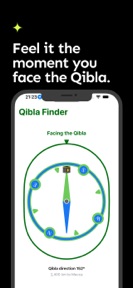


Dhikr Counter: Salah & Qibla is a productivity utility for Muslim users on iOS that provides offline prayer times, Qibla direction, and dhikr counting.
The App DNA
What makes this app unique?
Users hire this app to manage daily religious rituals without requiring an active internet connection, serving a need for privacy and reliability in low-connectivity environments.
For Muslim users seeking a digital tool for daily prayer tracking, Qibla direction, and dhikr counting.
What does it look like?
Key features
Calculates prayer times locally on the device.
Tracks prayer history with a year-long map and streaks.
How much does it cost?
The app is currently offered as a free utility with no visible subscription or IAP gates.
Velocity
Maintenance developmentUX improvementsinternationalizationperformanceShow more...
The app shows a maintenance-level cadence with only one release recorded in the recent window, resulting in a frequency of approximately 0.04 releases per week. The latest version is a major architectural overhaul, introducing on-device prayer time calculations, expanded calculation methods, and new statistical tracking features. There is no evidence of a recurring live-ops schedule or frequent iterative updates. Development appears focused on core utility and feature expansion rather than rapid, iterative deployment.
Who built it?
Furkan YILDIZ
3 apps tracked · Productivity
 Shopping List - Sync Lists
 Fast Qibla Finder
User Sentiment
What do users think recently?
How are ratings & reviews evolving?
Not enough recent reviews to extract reliable themes yet.
Read the full review analysisCompetition
Competitive landscape for Dhikr Counter: Salah & Qibla
How's the Productivity market?
The app occupies a utility-focused position in the Productivity category, relying on offline-first mechanics to differentiate from ad-heavy alternatives.
Read the market outlookThe rivals identified
Unlock the deeper market read.
Access the full report for freeThe Analyst's Read
Key takeaways for Dhikr Counter: Salah & Qibla
Where is it heading?
The prayer-utility market is consolidating around apps that offer automated, location-aware services, leaving offline-focused tools like this one in a stable but niche position. The app's future hinges on whether it can transition from a static utility to a habit-tracking platform before competitors with higher update cadences integrate similar offline capabilities.
- The latest rebuild introduces offline-first prayer calculations, which provides a defensible utility barrier against ad-supported competitors that require constant connectivity.
- The app operates on a maintenance-mode release cadence, which limits its ability to iterate on user feedback or expand its feature set.
The SWOT
- Offline-first architecture functions in low-connectivity environments
- Streak-based habit tracking provides daily retention mechanism
- Zero-monetization model lowers barrier to entry
- Wearable integration captures hands-free counting demand
- B2B partnerships with prayer groups drive discovery
Next best moves
A/B test a non-intrusive donation or premium-feature gate because the current free-only model lacks a sustainability path → increase developer runway
+ 1 more prioritized moveThe counter-intuitive read
The app's lack of monetization is a strategic liability, not a feature…
Read the full takeSince the last report: The app's competitive strategy shifted from maintenance-focused utility to active exploration of monetization and wearable hardware integration.
Bottom line
Dhikr Counter: Salah & Qibla secures a niche through offline reliability, but the lack of a monetization loop or social retention mechanism leaves it exposed to feature-rich rivals, so the PM should prioritize a low-friction monetization test to fund future development.
Unlock 3 critical frictions, 2 market threats, 1 more prioritized move and the analyst’s take.
Access the full report for freeSources
- [1] App Store, source
Report last updated