


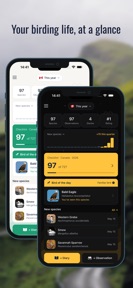


DiBird is a bird-watching journal for iOS and Android that enables users to log sightings, track life lists, and browse global species checklists.
The App DNA
What makes this app unique?
Birders require a private space to record sightings without the risk of exposing precise habitat coordinates to the public.
For Ornithology enthusiasts and bird watchers seeking a private, digital alternative to paper field journals.
What does it look like?
Key features
Taxonomy database with photos and sounds for 11,000+ species, acting as a retention loop for daily reference.
Public sightings are obscured within a 6x6 km area to protect exact user coordinates.
CSV-based migration tool for existing life lists from eBird.
How much does it cost?
The app operates on a donation-based model, requesting financial support via the website to avoid service closure.
Velocity
Maintenance developmentnew contentUX improvementsShow more...
DiBird maintains a maintenance-tier velocity, with only one distinct version released in the observed window. The latest update demonstrates a focus on feature expansion, specifically regarding ornithological data, audio integration, and user data portability. Development appears stable but infrequent, with the most recent update occurring 16 days ago. The current cadence suggests a focus on periodic, content-heavy feature drops rather than rapid iteration.
Who built it?
User Sentiment
What do users think recently?
How are ratings & reviews evolving?
Not enough recent reviews to extract reliable themes yet.
Read the full review analysisCompetition
Competitive landscape for DiBird – Bird Watching Journal
How's the Reference market?
DiBird operates as a niche reference tool, prioritizing privacy over the social network effects that drive the broader birding category.
Read the market outlookThe rivals identified
Unlock the deeper market read.
Access the full report for freeThe Analyst's Read
Key takeaways for DiBird – Bird Watching Journal
Where is it heading?
The birding reference market is consolidating around tools that offer both deep taxonomy and social data sharing. DiBird remains advantaged in the privacy-conscious segment, but must address its funding model to survive against larger, ad-supported or venture-backed competitors.
- The latest release (v26.08.0) adds global taxonomy and audio integration, signaling active feature investment rather than maintenance mode.
- The 16-day release cadence suggests a steady development pace, though the lack of social features limits potential viral growth.
The SWOT
- Privacy-first location masking protects sensitive habitat data
- Offline-capable species taxonomy drives daily utility
- Localized taxonomy could capture untapped international markets
Next best moves
Implement a 'Pro' subscription tier because the current donation model lacks sustainable funding → ensure long-term service stability
The counter-intuitive read
The lack of a social-first discovery feed is a feature, not a bug…
Read the full takeSince the last report: The developer has pivoted from a donation-only funding model to an active investment in a 'Pro' subscription tier, while sharpening the app's market identity as a privacy-focused reference tool rather than a social platform.
Bottom line
DiBird's privacy-focused design creates a defensible niche for serious birders, but the donation-only model limits its ability to compete with larger, well-funded platforms. Transitioning to a sustainable revenue model is necessary to ensure the app's long-term viability.
Unlock 1 critical friction, 1 market threat and the analyst’s take.
Access the full report for freeFAQ
Is DiBird free to use?
How does DiBird protect my birding locations?
Can I import my existing bird list from eBird?
Sources
- [1] Developer website, source
Report last updated