


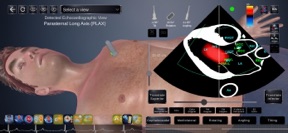


Echo Simulator is an extended reality cardiac education platform for medical students and clinicians, featuring interactive 3D anatomy and echocardiography simulation on mobile devices.
The App DNA
What makes this app unique?
The platform removes the cognitive friction of visualizing complex spatial relationships in cardiac physiology by providing real-time, synchronized 3D manipulation of blood flow and electrical activation.
For Medical students, residents, fellows, and clinical institutions requiring high-fidelity cardiac simulation for training.
What does it look like?
Key features
Interactive 3D rendering of cardiac structures, blood flow, and electrical activation for mobile devices.
Simulates TTE, TEE, and ICE imaging modalities with probe positioning controls.
Adjustable playback speed for analyzing cardiac cycles and conduction pathways.
How much does it cost?
The high-ticket, one-time purchase model targets institutional and professional medical users rather than mass-market consumers.
Velocity
Maintenance developmentperformanceplatform expansionShow more...
Echo Simulator currently operates at a maintenance cadence, with only one release shipped in the last 52 days. The latest version focused exclusively on technical stability and device compatibility rather than new content or features. Development appears stable but limited to periodic maintenance updates. There is no evidence of a live-ops strategy or frequent feature iteration.
Who built it?
User Sentiment
What do users think recently?
How are ratings & reviews evolving?
Not enough recent reviews to extract reliable themes yet.
Read the full review analysisCompetition
Competitive landscape for Echo Simulator
How's the Medical market?
Echo Simulator maintains a premium position in the medical education category with a $999.99 price point. The current 5-star rating across three reviews reflects high satisfaction among early professional adopters, though the lack of volume limits broader market validation.
Read the market outlookThe rivals identified
Unlock the deeper market read.
Access the full report for freeThe Analyst's Read
Key takeaways for Echo Simulator
Where is it heading?
The medical XR education market is shifting toward institutional-wide adoption to justify high software costs. Echo Simulator is currently positioned as a niche professional tool, and its future growth depends on moving from individual sales to institutional partnerships to secure a stable revenue stream.
- The maintenance-only release cadence suggests the core simulation engine is stable, but limits the platform's ability to respond to new clinical training standards.
- The 5-star rating from early professional users validates the high-fidelity visualization, which is the primary differentiator against static medical textbooks.
The SWOT
- Multi-modal echocardiography simulation (TTE, TEE, ICE) provides a comprehensive training tool for clinical fellows.
- Real-time 3D cardiac visualization enables spatial understanding of complex hemodynamics that static media cannot replicate.
- Institutional licensing programs could lower the barrier for medical schools, increasing adoption beyond individual professional purchases.
- Integration of standardized testing modules would align the platform with medical board certification requirements.
Next best moves
Develop institutional licensing tiers because the $999.99 price point limits individual student adoption → increase user base volume
+ 1 more prioritized moveThe counter-intuitive read
The high price point is not a weakness…
Read the full takeSince the last report: The platform has formalized its transition toward institutional-focused development, prioritizing enterprise deployment tools over new clinical simulation modules. This shift addresses the disconnect between the premium price point and the procurement habits of medical education institutions.
Bottom line
Echo Simulator provides high-fidelity cardiac training that justifies its premium price for institutional users, but the current maintenance-mode cadence risks stagnation. Transitioning to an institutional licensing model would unlock broader adoption and provide the recurring revenue needed to sustain development.
Unlock 2 critical frictions, 2 market threats, 1 more prioritized move and the analyst’s take.
Access the full report for freeSources
- [1] App Store, source
Report last updated