
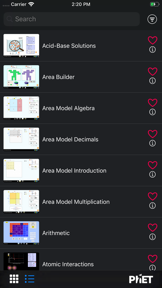


PhET Simulations is an educational app providing 75+ interactive science and math simulations for K-12 students and teachers on iOS and Android.
Product velocity
Dormant
Daily rank 🇺🇸
#39
▲12Education · paid
Sentiment
4.7
701 reviews
Nemesis

Khan Academy
The App DNA
What makes this app unique?
Users hire PhET for research-backed, portable STEM discovery that works offline, serving the need for reliable classroom tools where internet access is inconsistent.
For K-12 students, parents, and educators seeking interactive, research-based STEM learning tools for home or classroom use.
What does it look like?
Key features
Enables full simulation functionality without an active internet connection
Provides simulation interfaces in multiple languages for bilingual learners
Provides access to over 75 interactive science and math simulations
How much does it cost?
Paid model at $0.99 per download, with proceeds explicitly reinvested into the development of additional HTML5 simulations.
Velocity
Dormant developmentperformanceinternationalizationShow more...
The app has entered a zombie state, with no releases recorded in the last 19 months. The development cadence has effectively ceased, as the most recent update was over a year and a half ago. There is no evidence of active maintenance, feature development, or live operations. The lack of recent activity suggests the project is no longer being actively updated on these platforms.
Who built it?
University of Colorado Boulder
11 apps tracked · Education
 CU Boulder Life
 CrowdMag
 SOS Explorer
 CU Boulder Safe
 CU Boulder Wise Law Library
 BATP Collect
 Project SPECTRA!
 Science at 100,000 Feet
 Citizen Sky View
 CU Face Race
User Sentiment
What do users think recently?
Recent user voice shows a mixed sentiment. Users appreciate interactive science simulations provide high educational value for students and home learners, but report technical instability and loading failures prevent access to core simulation content.
How are ratings & reviews evolving?
What users say, by theme
- Interactive science simulations provide high educational value for students and home learners
- Technical instability and loading failures prevent access to core simulation content
90 of 90 recent reviews analyzed · high confidence · Mixed overall
Read the full review analysisUnlock 1 user request, each backed by review evidence.
Access the full report for freeCompetition
Competitive landscape for PhET Simulations
How's the Education market?
PhET Simulations maintains a consistent top-10 presence in the Paid Education category across multiple global markets, including the US and UK. The stable chart position despite technical complaints suggests high brand equity among educators.
Read the market outlookThe rivals identified
By Khan Academy
Directly competes in the educational science and math space with a massive, free-to-access content library.
- Offers a comprehensive, structured curriculum across multiple subjects rather than isolated, single-topic simulations.
- Provides personalized progress tracking and mastery points that incentivize long-term user retention.


Unlock the deeper market read.
Access the full report for freeThe Analyst's Read
Key takeaways for PhET Simulations
Where is it heading?
The STEM education market is shifting toward AI-assisted, personalized learning, which places PhET's static simulation model at a competitive disadvantage. The app's future depends on resolving technical friction to maintain its role as a reliable classroom utility before the user base migrates to more modern, adaptive alternatives.
- Persistent loading failures in the latest version erode the daily active habit, which compounds the rating drag already visible on Android.
- The offline-first architecture remains a unique differentiator for international classroom use, insulating the app from competitors that require constant internet connectivity.
The SWOT
- Research-based pedagogical design establishes category authority
- Offline-first architecture functions as a B2B distribution moat
- Multi-language support enables international classroom adoption
- Expansion of the mobile library to include advanced physics topics
- Integration with classroom management software for teacher monitoring
Next best moves
Audit loading sequence because loading failures are the #1 complaint theme → improve retention
+ 1 more prioritized moveThe counter-intuitive read
The app's offline capability is a stronger B2B…
Read the full takeFeature gaps
Personalized progress tracking (available in Khan Academy) +2
Since the last report: The app has entered a period of development inactivity, resulting in technical regressions and a shift in competitive positioning from a stable academic tool to one struggling with modern device compatibility.
Bottom line
PhET Simulations holds its category lead through academic authority, but persistent loading failures threaten to erode user trust, so the PM must prioritize technical stability over library expansion to prevent churn to free alternatives.
Unlock 3 critical frictions, 3 market threats, 1 more prioritized move and the analyst’s take.
Access the full report for freeReport last updated