




English Dictionary - Offline is a reference app providing local word definitions and search tools for students and writers on iOS and Android.
The App DNA
What makes this app unique?
Users hire this app for reliable, zero-latency word lookups in environments without internet access, avoiding the data overhead of cloud-dependent competitors.
For Students, writers, and language learners requiring reliable, offline access to English definitions and advanced search tools.
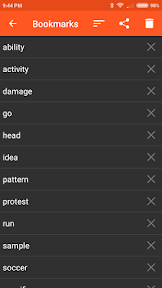
What does it look like?
Key features
Full word definitions and inflected forms stored locally on the device.
Plugin-based text recognition via back camera to look up physical text.
Search syntax using wildcards to find words matching specific patterns.
How much does it cost?
Monetization relies on ad-supported free usage with a direct conversion path to an ad-free experience.
Velocity
Maintenance developmentperformanceopaqueShow more...
The app ships approximately 0.18 releases per week, placing it firmly in the maintenance tier. Development is characterized by infrequent, minor updates focused on dictionary content and general stability rather than new feature development. There is no evidence of live operations or significant feature expansion in the observed data. The release cadence has remained stable but low over the last six months.
Who built it?
ZeeAlpha Tech
3 apps tracked · Reference
 9Xtream - Download & Play iPTV
 Everyday Tools - All in One
User Sentiment
What do users think recently?
The recent review mood reads thrilled. Users appreciate reliable offline functionality allows users to access definitions without requiring an active internet connection, but report lack of synonym and thesaurus features limits the utility for advanced writing and vocabulary expansion.
How are ratings & reviews evolving?
What users say, by theme
- Reliable offline functionality allows users to access definitions without requiring an active internet connection
- Lack of synonym and thesaurus features limits the utility for advanced writing and vocabulary expansion
50 of 50 recent reviews analyzed · high confidence · Thrilled overall
Read the full review analysisUnlock 1 user request, each backed by review evidence.
Access the full report for freeCompetition
Competitive landscape for English Dictionary - Offline
How's the Reference market?
The app maintains a strong Android presence with over 416,000 ratings, but its #100+ ranking in major markets signals that the simple dictionary format is losing ground to AI-driven translation tools.
Read the market outlookThe rivals identified

By Innnovative-Software
Both apps target the offline-first utility segment for language learners, with the rival capturing the bilingual market in Bangladesh while this app focuses on general English definitions.
- Rival integrates system-level sharing for word lookups, whereas this app requires manual input.
- Rival provides OCR technology for physical media extraction, a feature absent from this app.
 English Spanish DictionaryContender
 English Myanmar DictionaryContender
 English Bangla DictionaryContender
 Amharic/English DictionaryContender
 Portuguese/English DictionaryContender
Unlock the head-to-head verdict: where this rival wins, and where it loses.
Access the full report for freeThe Analyst's Read
Key takeaways for English Dictionary - Offline
Where is it heading?
The reference category is consolidating around AI-driven contextual tools, leaving simple dictionary apps exposed. The subject app must transition from a static definition tool to a prosumer utility to maintain its current user base.
- The latest update successfully resolved hardware compatibility issues, maintaining the high sentiment baseline established in previous versions.
- The lack of thesaurus features is driving power users toward more comprehensive translation suites, which will accelerate churn in the professional segment.
The SWOT
- Offline-first architecture eliminates server-side latency
- Dictionary API enables B2B distribution into third-party apps
- Ad-free IAP conversion path sustains revenue without degrading UX
- Integration of industry-specific terminology to capture professional segments
- Expansion of OCR plugin capabilities to support more languages
Next best moves
Ship thesaurus and synonym integration because user reviews flag it as the top missing feature → increase retention of power users
+ 1 more prioritized moveThe counter-intuitive read
The app's reliance on Wiktionary is not a weakness but a moat…
Read the full takeFeature gaps
Thesaurus and synonym tools (available in Dictionary.com) +1
Since the last report: The app adopted a freemium monetization model and added OCR camera search, while user feedback highlighted a critical gap in thesaurus functionality.
Bottom line
The app excels as a lightweight, offline utility, but it risks commoditization by feature-rich competitors, so the PM should prioritize thesaurus integration to retain advanced users.
Unlock 3 critical frictions, 2 market threats, 1 more prioritized move and the analyst’s take.
Access the full report for freeReport last updated