


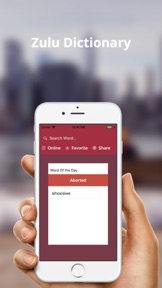
English to Zulu Translator is an offline dictionary and translation tool for English and Zulu language learners on iOS.
The App DNA
What makes this app unique?
Users hire this app for quick, offline word lookups in low-connectivity environments, serving a functional need for basic linguistic reference.
For Language learners and bilingual speakers requiring offline translation tools for English and Zulu.
What does it look like?
Key features
Access to 60,000+ words without an active internet connection
Translate words directly from internet browsers or other applications via the share menu
In-app audio playback for English and Zulu word pronunciation
Local storage for specific English and Zulu word pairs
How much does it cost?
The app is currently distributed as a free utility with no visible in-app purchase or subscription gates.
Velocity
Dormant developmentShow more...
The app has not received a single update since its initial release in September 2018. With no development activity for over 89 months, the project is classified as a zombie. There is no evidence of ongoing maintenance, feature development, or live operations.
Who built it?
Translation and Voice Typing Apps
13+ apps tracked · Education
 English to Telugu Translator
 Greek to English Translator
 Swedish to English Translator
 English to German Translator .
 English to Assamese Translator
 Lithuanian English Translator
 Arabic to English Translator
 English to Sinhala Translator
 Bulgarian English Translator
 English to Romanian Translator
 English to Bengali Translator
 English to Oromo Translator
User Sentiment
What do users think recently?
How are ratings & reviews evolving?
Not enough recent reviews to extract reliable themes yet.
Read the full review analysisCompetition
Competitive landscape for English to Zulu Translator
How's the Education market?
The app maintains a static presence with no updates since its 2018 release, resulting in a 1.0 rating on the iOS platform.
Read the market outlookThe rivals identified
Unlock the deeper market read.
Access the full report for freeThe Analyst's Read
Key takeaways for English to Zulu Translator
Where is it heading?
The language learning market is consolidating around AI-integrated tools that offer real-time feedback and gamified retention, leaving static dictionary apps like this one increasingly obsolete. The lack of development activity suggests the app will continue to lose market share, so the PM should focus on stability or consider sunsetting the project.
- The lack of updates since 2018 indicates the app is in maintenance-mode, which prevents it from competing with modern AI-driven language tools.
- A 1.0 rating on the iOS platform signals that the current user experience is failing, which will continue to drive churn to active competitors.
The SWOT
- System-wide share menu integration reduces friction
- 60,000+ word offline library ensures utility
- AI-based pronunciation feedback integration
- Gamified daily challenges for retention
Next best moves
Audit codebase for OS compatibility because the app has not been updated since 2018 → prevent total app failure
The counter-intuitive read
The app's lack of updates is not just…
Read the full takeFeature gaps
Real-time AI pronunciation feedback (available in Articulate: Speech Trainer but missing here) +2
Since the last report: The app remains in a zombie state with no functional updates, while the competitive landscape has been re-indexed to focus on specialized language-learning and speech-training tools.
Bottom line
The app provides basic offline utility but lacks the engagement loops required to compete with modern language tools, so the PM should prioritize a stability audit to prevent total failure before considering any feature expansion.
Unlock 3 critical frictions, 2 market threats and the analyst’s take.
Access the full report for freeReport last updated