


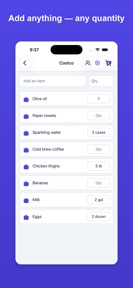


EZlist is a cross-platform shared shopping list app for families and roommates that synchronizes grocery items in real time across iOS, Android, and the web.
The App DNA
What makes this app unique?
The app removes the cognitive load of managing categories and units, serving households that need a shared, low-friction tool for grocery shopping.
For Families and roommates requiring a shared, low-friction tool for grocery shopping and household maintenance tasks.
What does it look like?
Key features
Organizes items into distinct lists mapped to specific physical store locations.
Multi-user synchronization of shopping lists via email invite, reflecting edits instantly across all connected devices.
Enables list viewing and item check-off without network connectivity, with background sync upon reconnection.
How much does it cost?
EZlist is currently free to use across all platforms with no observable IAP or ad-supported gates.
Velocity
Maintenance developmentperformanceopaqueShow more...
With only one release in the observed window, the app operates on a maintenance cadence of approximately one update every three weeks. The latest release focused exclusively on performance and minor improvements, providing no indication of new feature development. Development appears stable but limited to technical upkeep rather than active expansion or live operations.
Who built it?
User Sentiment
What do users think recently?
How are ratings & reviews evolving?
Not enough recent reviews to extract reliable themes yet.
Read the full review analysisCompetition
Competitive landscape for EZlist: Shared Shopping List
How's the Productivity market?
EZlist occupies the minimalist productivity space, competing against established system-level reminders and dedicated grocery apps. The absence of monetization signals a focus on user growth rather than immediate revenue extraction.
Read the market outlookThe rivals identified
Unlock the deeper market read.
Access the full report for freeThe Analyst's Read
Key takeaways for EZlist: Shared Shopping List
Where is it heading?
The grocery list market is consolidating around integrated productivity suites, leaving standalone apps like EZlist exposed. Without a clear path to monetization or a unique social-sharing loop, the app risks becoming a temporary utility rather than a long-term household habit.
- The 21-day maintenance cadence suggests a stable, low-intensity development phase rather than an aggressive push for market share.
- The absence of a monetization model creates a long-term sustainability risk as server costs scale with user growth.
The SWOT
- Per-store list segmentation enables physical-aisle efficiency
- Real-time sync removes household communication friction
- Invite-link sharing for non-registered users
- Localized grocery store integration partnerships
Next best moves
Implement invite-link sharing because it lowers the friction for new household members → increase user acquisition
The counter-intuitive read
The lack of monetization is a strategic risk…
Read the full takeSince the last report: The platform pivoted its strategic outlook from viewing the absence of monetization as a competitive advantage to identifying it as a sustainability risk. Development focus shifted toward implementing invite-link sharing to address onboarding friction.
Bottom line
EZlist's per-store list segmentation provides a clear utility advantage, but the lack of a defined revenue model leaves the service vulnerable to platform-native competitors that do not require a separate install.
Unlock 2 critical frictions, 2 market threats and the analyst’s take.
Access the full report for freeFAQ
Is EZlist free to use?
Does EZlist work without an internet connection?
What makes EZlist different from a standard notes app?
Sources
- [1] App Store, source
Report last updated