


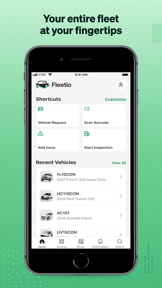



Fleetio Go is a fleet management mobile app for managers, drivers, and technicians to track maintenance and inspections.
The App DNA
What makes this app unique?
Users hire Fleetio Go to replace manual spreadsheets with a centralized, mobile-accessible system for vehicle health and maintenance history.
For Fleet managers, drivers, and technicians at organizations ranging from small businesses to large enterprises.
What does it look like?
Key features
Analyzes repair orders and flags exceptions against maintenance history.
Integration with 80,000+ third-party shops for outsourced maintenance approvals.
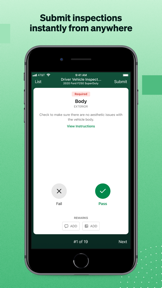
Digital vehicle inspection reports submitted directly from mobile devices.
How much does it cost?
Strict B2B subscription model requiring a paid web-based management account to unlock mobile app functionality.
Velocity
Active developmentUX improvementsperformanceinternationalizationShow more...
The app maintains an active development pace with releases occurring approximately every 5-6 days across iOS and Android. Development is currently focused on enhancing core fleet management utility, including inspection modules, barcode scanning, and offline error handling. The release strategy is feature-rich, with clear documentation of improvements rather than opaque updates. The current cadence suggests a stable, feature-driven development cycle.
Who built it?
User Sentiment
What do users think recently?
How are ratings & reviews evolving?
Not enough recent reviews to extract reliable themes yet.
Read the full review analysisCompetition
Competitive landscape for Fleetio Go - Fleet Management
How's the Business market?
Fleetio Go maintains a consistent presence in the Business category, with a 4.58 rating on iOS and 4.31 on Android. The app's requirement for a web-based subscription limits its reach compared to standalone mobile-first tools.
Read the market outlookThe rivals identified

By Lytx, Inc.
Lytx competes directly for the attention of fleet personnel by focusing on driver safety, telematics, and compliance, which are critical components of the broader fleet management ecosystem Fleetio serves.
- Deep integration with hardware-based road condition mapping and performance trend analysis for driver coaching
- Specialized ELD service compliance tools that provide a distinct safety-first value proposition over general maintenance


Unlock the head-to-head verdict: where this rival wins, and where it loses.
Access the full report for freeThe Analyst's Read
Key takeaways for Fleetio Go - Fleet Management
Where is it heading?
Fleetio Go faces a consolidating market where shop-floor efficiency tools are increasingly integrated with technical repair data. The current reliance on a web-subscription gate leaves the app exposed to mobile-first entrants that offer lower-friction, standalone workflows.
- Recent updates focus on maintenance history and work order management, signaling a commitment to deep-fleet operational depth rather than casual-user expansion.
- Competitive pressure from shop-floor-specific apps forces a pivot toward more granular technician tools to prevent churn in the maintenance segment.
The SWOT
- Maintenance Shop Network functions as a B2B distribution barrier
- AI Service Advisor flags maintenance exceptions to increase platform stickiness
- Untapped education partnerships for B2B distribution
- Wearable integration for technician hands-free inspection
Next best moves
Ship offline-first inspection mode because current reliance on connectivity hampers remote-fleet adoption → increase daily active usage
The counter-intuitive read
The subscription-only model is not a weakness but…
Read the full takeFeature gaps
Integrated technical data access (available in Shopmonkey but absent here) +1
Since the last report: The product strategy shifted focus toward offline-first inspection capabilities to improve remote-fleet adoption, while competitive threats were re-evaluated to emphasize technical data and hardware-centric coaching.
Bottom line
Fleetio Go secures fleet maintenance through a comprehensive digital lifecycle, but its reliance on a web-based subscription limits mobile-only accessibility, so the PM should prioritize offline-first inspection features to capture remote-fleet segments.
Unlock 2 critical frictions, 2 market threats and the analyst’s take.
Access the full report for freeSources
Report last updated