



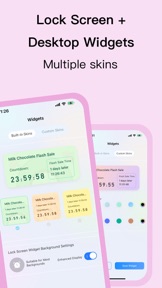
Floating Clock is a productivity utility for iOS and Android that provides millisecond-precision timing and automated page redirection for e-commerce flash sales.
The App DNA
What makes this app unique?
The app removes the temporal friction of manual timing during high-stakes shopping events, allowing users to execute purchases at the exact moment sales open.
For E-commerce shoppers and users participating in time-limited flash sales for high-demand items like concert tickets or limited-edition goods.
What does it look like?
Key features
Floating overlay providing millisecond-precision timing for time-sensitive tasks
Automated redirection to specific e-commerce sale pages at a set time
Visual adaptation to iOS Dynamic Island for time tracking
How much does it cost?
The app operates on a free-to-use model with no visible IAP or subscription gates, focusing on user base growth.
Velocity
Intense developmentShow more...
5 versions in history. Development pace: intense.
Who built it?
Hangzhou OrangeJuice Technology Co.
10 apps tracked · Productivity
 BluetoothAssistant
 Relax Eyes-Pro
 Coin-Floating
 AR Compass 3D
 Electronic medical record
 Tricolor Time
 Entry Memo
 橘汁智慧餐饮
 语音通知
语音通知User Sentiment
What do users think recently?
How are ratings & reviews evolving?
Not enough recent reviews to extract reliable themes yet.
Read the full review analysisCompetition
Competitive landscape for Floating Clock
How's the Productivity market?
Floating Clock holds a #2 free rank in the Taiwan productivity category, signaling strong regional adoption. The gap between its iOS (4.7) and Android (4.1) ratings indicates potential platform-specific UX friction that could hinder cross-platform retention.
Read the market outlookThe rivals identified

By Shenzhen Gude Aipu Technology Co., Ltd
Both apps target flash-sale participants by providing millisecond-precision floating overlays to reduce temporal friction during high-stakes purchases.
- Top Clock includes Pomodoro and interval timers for non-shopping tasks like learning and cooking.
- Top Clock allows users to adjust the size and position of the floating picture-in-picture window.
- Top Clock provides color customization options for the floating interface.
 FloClock - Flash Sale ClockContender
 Gaber: Flash Sale ClockContender
 Second Clock & CountdownContender
 Sale Countdown & Deal TimerContender
Unlock the head-to-head verdict: where this rival wins, and where it loses.
Access the full report for freeThe Analyst's Read
Key takeaways for Floating Clock
Where is it heading?
The market for flash-sale utility tools remains stable, but Floating Clock's reliance on platform-specific features like Dynamic Island makes it vulnerable to OS-level changes. Addressing the Android rating disparity is essential to prevent churn as the user base expands beyond its current regional strongholds.
- Strong regional chart performance in Taiwan and Hong Kong indicates high product-market fit for flash-sale utility tools.
- The persistent rating gap between Android and iOS suggests technical debt on Android that could accelerate churn as user expectations rise.
The SWOT
- Millisecond-precision timing overlay provides a functional advantage in competitive flash sales
- Dynamic Island integration sustains visibility during background tasks on iOS
- Automated navigation to sale pages reduces manual input friction for time-sensitive tasks
- Localized marketing in high-ARPU markets could capture users currently relying on manual timing methods
- Expanding AI translation features could attract cross-border e-commerce shoppers
Next best moves
Audit Android UX flow because the 0.6 rating gap vs iOS suggests platform-specific friction → improve Android retention
+ 1 more prioritized moveThe counter-intuitive read
The app's lack of monetization is not a…
Read the full takeSince the last report: Floating Clock has shifted from a generic utility to a more targeted competitive tool by elevating core features to differentiators and formalizing a roadmap to address platform-specific performance gaps. The app now explicitly targets high-stakes e-commerce shoppers with system-level UI integrations.
Bottom line
Floating Clock provides high-utility timing tools that retain power shoppers, but the lack of monetization and the Android-iOS rating gap create long-term sustainability risks. Addressing platform parity would unlock better retention, while a premium tier would capitalize on the app's high utility.
Unlock 2 critical frictions, 2 market threats, 1 more prioritized move and the analyst’s take.
Access the full report for freeSources
- [1] App Store, source
Report last updated