


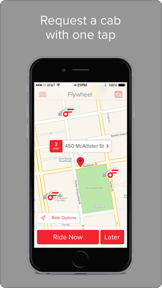



Flywheel is a taxi-hailing app that connects urban commuters with licensed taxi fleets across select US cities.
The App DNA
What makes this app unique?
Users hire Flywheel to access regulated, fixed-rate taxi services without the volatility of surge pricing, prioritizing reliability over the dynamic pricing models of private-hire competitors.
For Urban taxi riders and municipal taxi fleet operators.
What does it look like?
Key features
Replaces traditional taxi meters with a smartphone application.
Automated payment processing for driver earnings.
Physical partition system for taxi compartments.
How much does it cost?
Revenue is B2B-focused, targeting taxi fleets and municipalities rather than consumer-side subscriptions.
Velocity
Maintenance developmentperformanceinternationalizationUX improvementsShow more...
The app has released only 5 updates over the last 14 months, averaging approximately 0.08 releases per week, which places it firmly in the maintenance tier. Development activity is characterized by infrequent, minor stability updates rather than consistent feature iteration. The latest release provides only generic performance improvements, and there is no evidence of live-ops or recurring content cycles. The development trend is stable at a low-frequency maintenance level.
Who built it?
User Sentiment
What do users think recently?
How are ratings & reviews evolving?
Not enough recent reviews to extract reliable themes yet.
Read the full review analysisCompetition
Competitive landscape for Flywheel - The Taxi App
How's the Travel market?
Flywheel operates in the Travel category, competing as a digital layer for legacy taxi fleets. The low rating (2.1 on Android) relative to its long tenure indicates that the current interface is failing to meet modern user expectations for ride-booking speed.
Read the market outlookThe rivals identified
Unlock the deeper market read.
Access the full report for freeThe Analyst's Read
Key takeaways for Flywheel - The Taxi App
Where is it heading?
The urban ride-booking market is consolidating around apps that offer high-performance UI and transparent pricing, leaving Flywheel's legacy-focused model exposed. Without a shift toward modernizing the consumer experience, the app will continue to lose market share to competitors like RideYellow that prioritize user-facing features over B2B-only utility.
- The lack of feature updates in the latest release cycle signals a shift toward maintenance-mode, which leaves the app vulnerable to agile, UI-focused competitors.
- The 2.1 Android rating indicates that the current interface is failing to meet user expectations, which will accelerate churn to modern ride-booking alternatives.
The SWOT
- Licensed taxi integration provides a regulatory safety barrier [B2B licensing model]
- Fixed-rate pricing model protects riders from surge-pricing volatility [Pricing Strategy]
- Integration of upfront pricing could neutralize the primary advantage of RideYellow [Market Positioning]
- Expansion of request filtering could capture users with specialized transit needs [Feature Gaps]
Next best moves
Implement upfront pricing for all rides because RideYellow's transparency is a primary competitive threat → increase conversion
+ 1 more prioritized moveThe counter-intuitive read
Flywheel's low consumer rating is a secondary concern to its B2B fleet-licensing moat…
Read the full takeFeature gaps
Upfront pricing (available in RideYellow but missing here) +2
Since the last report: The report reflects a shift in product strategy from B2B-only focus toward addressing consumer-facing UI and pricing transparency gaps.
Bottom line
Flywheel maintains a stable B2B revenue stream through its fleet-licensing model, but the consumer-facing app is losing relevance due to a dated interface and lack of price transparency, so the PM must prioritize UI modernization and upfront pricing to prevent further churn to agile competitors.
Unlock 2 critical frictions, 2 market threats, 1 more prioritized move and the analyst’s take.
Access the full report for freeReport last updated