





Food Allergy Card is a travel-utility app that generates offline-accessible, multi-language dietary restriction cards for individuals with food allergies.
The App DNA
What makes this app unique?
It removes the cognitive and language friction of communicating dietary restrictions in high-stakes dining situations abroad where connectivity is unreliable.
For International travelers and individuals with food allergies requiring reliable, offline communication tools.
What does it look like?
Key features
Translates allergy info and plays text-to-speech audio without internet connectivity.
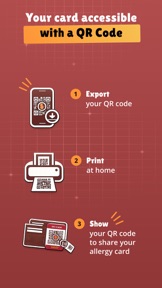
Generates unique QR codes for instant access by restaurant staff.
Exports cards into printable formats for physical storage.
How much does it cost?
Freemium model gates advanced features while maintaining a free base for core allergy communication.
Velocity
Maintenance developmentnew contentUX improvementsShow more...
Food Allergy Card ships approximately 0.25 releases per week, placing it in a maintenance tier. The development trend is stable, focusing on incremental feature additions and minor UI adjustments rather than rapid iteration. The latest release introduced a specific allergen request and improved the home screen layout. There is no evidence of live-ops or seasonal content, as the developer continues to ship functional updates at a measured pace.
Who built it?

User Sentiment
What do users think recently?
Recent user voice shows an upset sentiment.
How are ratings & reviews evolving?
What users say, by theme
- The current allergy database lacks sufficient breadth and depth to support users with diverse dietary restrictions
4 of 4 recent reviews analyzed · limited sample
Read the full review analysisUnlock 2 more frustration themes and 2 user requests, each backed by review evidence.
Access the full report for freeCompetition
Competitive landscape for Food Allergy Card
How's the Food & Drink market?
Food Allergy Card holds a 3.5-star rating on iOS with a very limited review sample. The lack of language support and customization options currently limits its market penetration compared to general-purpose translation tools.
Read the market outlookThe rivals identified
Unlock the deeper market read.
Access the full report for freeThe Analyst's Read
Key takeaways for Food Allergy Card
Where is it heading?
The travel-utility market is increasingly demanding flexible, user-defined tools, and Food Allergy Card's rigid database is falling behind. Without immediate investment in customization and language support, the app risks being replaced by general-purpose translation tools that offer better utility for the same core job.
- The inability to add custom allergens drives consistent negative feedback, which limits the app's utility for users with diverse dietary restrictions.
- Lack of multi-language support prevents effective communication in international travel, which is the core use case for the target audience.
The SWOT
- Offline-first architecture ensures reliability in remote travel environments.
- QR-based sharing enables instant access for non-users.
- Implementing user-defined allergen inputs would satisfy the top-requested feature.
- Expanding the translation engine would increase utility for non-English speaking markets.
Next best moves
Ship user-defined allergen input field because it is the #1 requested feature → increase user retention
+ 1 more prioritized moveThe counter-intuitive read
The app's offline-first design is its only defensible barrier…
Read the full takeBottom line
Food Allergy Card must prioritize user-defined allergen inputs to address the primary churn driver, as the current static database fails to support diverse dietary needs. Unlocking manual entry would transform the tool from a rigid template into a functional, personalized safety asset for travelers.
Unlock 3 critical frictions, 1 market threat, 1 more prioritized move and the analyst’s take.
Access the full report for freeSources
- [1] App Store, source
Report last updated