


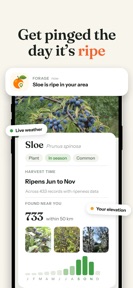

Forage is a foraging guide and plant identification app for outdoor enthusiasts, available on iOS and Android.
The App DNA
What makes this app unique?
Users report: It replaces static, unreliable harvest calendars with regional data derived from 3 billion GBIF records, removing the guesswork from finding wild food.
For Outdoor enthusiasts, foragers, and families interested in identifying and harvesting wild food with data-backed guidance.
What does it look like?
Key features
Computes regional harvest windows using 3 billion data points from GBIF and research collections rather than static calendars.
Uses camera input to identify species and provide lookalike warnings.
Logs finds with location, date, and notes to track personal foraging history.
How much does it cost?
Freemium model gates utility-heavy features like offline access and unlimited identification behind a Pro subscription.
Velocity
Active developmentnew contentUX improvementsShow more...
Forage: Wild Food Finder is currently in an active development phase, having shipped two updates within the last two weeks. The latest release provides functional improvements by adding a guide for identifying wild food and avoiding toxic lookalikes. This follows a period of minor maintenance, indicating a stable and ongoing effort to expand the app's utility. The development trend is currently stable with a focus on core feature expansion.
Who built it?
KEVIN BAUR
3 apps tracked · Lifestyle
 Dibs: AI Car Identifier
 Logbook & Journal - SeaMemo
User Sentiment
What do users think recently?
How are ratings & reviews evolving?
Not enough recent reviews to extract reliable themes yet.
Read the full review analysisCompetition
Competitive landscape for Forage: Wild Food Finder
How's the Lifestyle market?
Forage occupies a niche in the Lifestyle category, currently ranking #176 in Education (GB). The focus on GBIF-backed data differentiates the app from generalist identification tools, though the current rank suggests limited visibility in the broader market.
Read the market outlookThe rivals identified
Unlock the deeper market read.
Access the full report for freeThe Analyst's Read
Key takeaways for Forage: Wild Food Finder
Where is it heading?
Forage is moving toward a data-rich utility model that differentiates it from generic identification apps. The PM should focus on converting the current data-driven utility into a social network to reduce acquisition costs, as the current private-journal model limits organic growth.
- The latest release adds mushroom and herb identification, showing active feature investment rather than maintenance-mode stagnation.
- The current bi-weekly update cadence suggests a small team focused on steady feature expansion rather than rapid scaling.
The SWOT
- GBIF-backed seasonality data provides regional accuracy
- Camera-based identification scanner provides immediate utility
- Personal harvest journal creates long-term switching costs
- Expansion into regional foraging guides for Pro users
- Integration with regional outdoor trail maps
Next best moves
Ship offline map regions to free users because the current gate limits utility for remote foraging areas → increase top-of-funnel conversion
+ 1 more prioritized moveThe counter-intuitive read
The reliance on historical GBIF data is a risk, not a strength…
Read the full takeSince the last report: Forage has pivoted its roadmap toward social network integration and top-of-funnel expansion, while identifying climate-induced data volatility as a new competitive threat.
Bottom line
Forage's reliance on GBIF data provides a defensible utility that generalist apps lack. Pivoting the Pro tier toward social sharing would unlock the organic growth currently missing from the private harvest journal, which is the primary barrier to scaling.
Unlock 2 critical frictions, 2 market threats, 1 more prioritized move and the analyst’s take.
Access the full report for freeFAQ
Is Forage safe to use for identifying wild food?
How does Forage compare to general plant identification apps?
Is Forage free to use?
Sources
- [1] App Store listing, source
Report last updated