


Ginga: Brazilian Dictionary
By Jackson Rigg
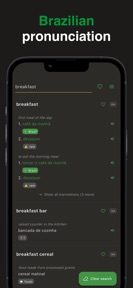


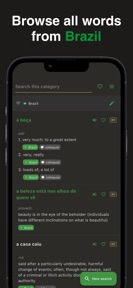
Ginga is an offline-first Brazilian Portuguese dictionary and verb conjugator for iOS, designed for travelers and students.
The App DNA
What makes this app unique?
The app removes the connectivity dependency that general-purpose translation tools require, providing reliable access to dialect-specific vocabulary in regions with limited internet.
For Travelers, business professionals, and students requiring specialized Brazilian Portuguese vocabulary and offline reference tools.
What does it look like?
Key features
Full access to 450,000 words and 275,000 example sentences without internet connectivity.
Vocabulary categorized by country of origin, including Brazil, Angola, Mozambique, and Portugal.
Conjugation tool for 5,400 verbs covering basic to advanced tenses.
How much does it cost?
Ginga operates as a free utility with no advertisements or in-app purchases, removing the monetization friction found in category rivals.
Velocity
Maintenance developmentnew contentUX improvementsShow more...
Ginga: Brazilian Dictionary is currently in a maintenance phase, having shipped only a single release in the observed window. The latest version introduced audio functionality, marking a shift toward feature expansion after a period of inactivity. Development momentum is currently low, with no evidence of a recurring release schedule. Future updates are expected to follow this sporadic, low-frequency pattern.
Who built it?
Jackson Rigg
2 apps tracked · Education
 Metropolitan French Dictionary
User Sentiment
What do users think recently?
How are ratings & reviews evolving?
Not enough recent reviews to extract reliable themes yet.
Read the full review analysisCompetition
Competitive landscape for Ginga: Brazilian Dictionary
How's the Education market?
Ginga occupies a niche utility space in the Education category, maintaining a 4.0-star rating on the App Store. The absence of monetization or ads positions it as a high-trust, low-friction tool for users prioritizing privacy and offline access.
Read the market outlookThe rivals identified
Unlock the deeper market read.
Access the full report for freeThe Analyst's Read
Key takeaways for Ginga: Brazilian Dictionary
Where is it heading?
The dictionary market is consolidating around AI-integrated tools that offer real-time, context-aware translation. Ginga's stable, offline-first position serves a specific traveler segment, but the lack of active feature development leaves it exposed to broader language-learning platforms that are increasingly adding offline capabilities.
- The latest release added audio playback, but the 48-day gap since the update suggests a maintenance-only posture rather than active growth.
- The absence of a structured learning loop limits the app to a one-off utility, which compounds the risk of user churn to broader AI tools.
The SWOT
- Offline-first architecture removes connectivity dependencies
- Dialect-specific categorization ensures higher linguistic precision
- Integrating spaced-repetition for saved words increases utility
Next best moves
Ship spaced-repetition flashcards for saved words because the current bookmarking feature lacks a retention loop → increase daily active usage
The counter-intuitive read
The lack of monetization is Ginga's primary weakness: without a revenue stream…
Read the full takeBottom line
Ginga's offline-first utility retains core users, but the maintenance-only cadence leaves it vulnerable to AI-driven competitors. Transitioning from a static reference tool to an active learning platform would unlock higher retention and defend against commoditization.
Unlock 2 critical frictions, 1 market threat and the analyst’s take.
Access the full report for freeFAQ
Is Ginga suitable for serious language learners?
Does Ginga require an internet connection?
What is the difference between Ginga and general translation apps?
Are there any hidden costs or ads in Ginga?
Sources
- [1] App Store
Report last updated