


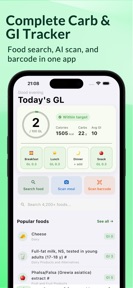

Glycemic Index - Load Tracker is a health-focused food diary for iOS and Android that calculates glycemic load using a clinical database.
The App DNA
What makes this app unique?
Users hire this app to manage blood sugar via precise glycemic load tracking, replacing generic calorie counters that lack clinical data accuracy.
For Individuals managing type 2 diabetes, prediabetes, or PCOS who require precise glycemic load tracking for blood sugar control.
What does it look like?
Key features
Camera-based food identification and portion estimation for real-time glycemic load calculation. [Revenue Link: Premium tier gate]
Access to 4,200+ foods with peer-reviewed glycemic index and load data. [Revenue Link: Brand trust / Retention]
Suggests low-GI alternatives for high-GI food entries with comparative impact metrics. [Revenue Link: Premium tier gate]
How much does it cost?
Freemium model gates high-utility AI features and historical data behind a weekly, monthly, or annual subscription.
Velocity
Maintenance developmentperformanceopaqueShow more...
The app maintains a slow release cadence, averaging approximately 0.17 releases per week over the analyzed period. Development is currently limited to minor performance improvements and bug fixes, with no evidence of new features or live operations. The release notes remain entirely opaque, providing no insight into specific functional changes. The development trend is stable at a maintenance level, with the most recent update occurring over two months ago.
Who built it?
Openbeta
4 apps tracked · Health & Fitness
 WorldLens - World Monitor
 Snore Tracker - Sleep Recorder
 Pantry Chef - Home Cooks
User Sentiment
What do users think recently?
How are ratings & reviews evolving?
Not enough recent reviews to extract reliable themes yet.
Read the full review analysisCompetition
Competitive landscape for Glycemic Index - Load Tracker
How's the Health & Fitness market?
The app occupies a specialized niche in the Health & Fitness category, relying on clinical data accuracy rather than chart-topping install volume. The lack of recent major updates suggests a focus on long-term retention of a core, high-intent user base rather than aggressive acquisition.
Read the market outlookThe rivals identified
Unlock the deeper market read.
Access the full report for freeThe Analyst's Read
Key takeaways for Glycemic Index - Load Tracker
Where is it heading?
The market for glycemic management is shifting toward automated biometric feedback, making manual logging apps like this one increasingly reliant on their database accuracy to retain users. If the app does not integrate with wearable data or increase its feature velocity, it will likely be relegated to a secondary reference tool rather than a primary health companion.
- The reliance on the University of Sydney database provides a defensible clinical moat that prevents churn to generic calorie trackers.
- A 75-day update gap suggests the developer is prioritizing stability over growth, which risks losing share to more active competitors.
The SWOT
- University of Sydney GI database provides a clinical-grade distribution barrier against generic calorie trackers
- Portion-accurate glycemic load calculation differentiates the app from standard carb-counting tools
- Integration with wearable glucose monitors would transition the app from a diary to a real-time health dashboard
- B2B partnerships with endocrinology clinics could leverage the clinical-grade database for patient-referral distribution
Next best moves
Integrate wearable glucose monitor data because manual logging is the #1 friction point → increase daily active usage
+ 1 more prioritized moveThe counter-intuitive read
The app's "maintenance mode" is a strategic choice…
Read the full takeSince the last report: The app's strategic focus shifted from internal AI accuracy improvements to the necessity of wearable glucose monitor integration to combat manual-entry friction.
Bottom line
Glycemic Index - Load Tracker secures its niche through clinical data accuracy, but its lack of feature momentum and manual-entry friction limit its growth, so the PM should prioritize wearable integration to stay relevant against biometric-first competitors.
Unlock 2 critical frictions, 2 market threats, 1 more prioritized move and the analyst’s take.
Access the full report for freeSources
Report last updated