




Gmail is a productivity app for email management, collaboration, and communication, available on iOS and Android.
The App DNA
What makes this app unique?
Users hire Gmail to centralize communication workflows and access Google Workspace tools, reducing the need to switch between disparate productivity apps.
For Individual users and business professionals seeking a centralized communication and collaboration hub integrated with Google Workspace.
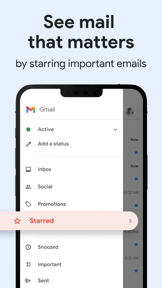
What does it look like?
Key features
AI-powered writing assistant, email summarization, and contextual Smart Reply functionality.
Direct access to Google Meet, Chat, Calendar, and Tasks within the Gmail interface.
Automated filtering blocking over 99.9% of spam, phishing, and malware.
How much does it cost?
Freemium model anchored by free core services, with advanced AI capabilities gated behind Google One subscriptions.
Velocity
Intense developmentperformanceopaqueShow more...
The app maintains an intense release cadence of approximately 0.8 to 1 release per week, primarily focused on iOS. Despite the high frequency of updates, the release notes remain consistently opaque, providing no insight into specific feature development or content changes. This pattern is characteristic of apps that utilize server-side configuration to manage features and experiments independently of the binary release cycle. The development trend is stable, prioritizing continuous maintenance and performance optimization over visible feature milestones.
Who built it?
13+ apps tracked · Productivity
 Google Family Link
 Google Earth
 YouTube Kids
 Google TV: Watch Movies & TV
 Google Docs
 Photomath
 Gboard – the Google Keyboard
 Google One
 Google Keep - Notes and lists
 Google News
 Snapseed: Photo Editor
 Google NotebookLM
User Sentiment
What do users think recently?
Fresh user feedback skews frustrated. Users appreciate centralized email management across multiple accounts provides significant convenience for daily communication workflows, but report post-update stability regressions cause frequent application crashes and blank screens during standard email navigation.
How are ratings & reviews evolving?
What users say, by theme
- Centralized email management across multiple accounts provides significant convenience for daily communication workflows
- Post-update stability regressions cause frequent application crashes and blank screens during standard email navigation
100 of 247 recent reviews analyzed · high confidence · Frustrated overall
Read the full review analysisUnlock 1 more frustration theme and 1 user request, each backed by review evidence.
Access the full report for freeCompetition
Competitive landscape for Gmail - Email by Google
How's the Productivity market?
Gmail holds the #16 Free rank on the US Overall chart, but its #100 Grossing rank lags significantly behind discovery. This gap signals that the current monetization strategy, specifically sponsored content and AI-tier gating, is underperforming relative to the app's massive install base.
Read the market outlookThe rivals identified
Unlock the deeper market read.
Access the full report for freeThe Analyst's Read
Key takeaways for Gmail - Email by Google
Where is it heading?
The email productivity market is shifting toward unified 'Work Hub' experiences that reduce tab-switching friction. Gmail's current trajectory is exposed by stability issues and ad-clutter, which creates a window for competitors like Microsoft Outlook to capture power users who prioritize workflow cohesion over ecosystem lock-in.
- Stability regressions in the latest build cause frequent crashes, which erodes the daily active habit and compounds existing rating drag.
- Aggressive monetization and forced AI features are driving user frustration, increasing the churn risk toward alternative email clients.
The SWOT
- Workspace integration creates high switching costs for enterprise users
- 99.9% spam-blocking efficacy sustains enterprise-grade security authority
- Untapped education partnerships for B2B distribution
- Expansion of wearable-specific productivity features
Next best moves
Rebuild stability in the latest release because crashes are the #1 complaint theme → restore baseline retention
+ 1 more prioritized moveThe counter-intuitive read
The 'AI race' framing misses that Gmail's moat is OS-level Workspace access…
Read the full takeFeature gaps
Unified 'Work Hub' UI (available in Microsoft Outlook but absent here) +1
Since the last report: Gmail's competitive position is declining as stability issues and ad-clutter erode user trust, overshadowing the app's core Workspace value proposition.
Bottom line
Gmail maintains its category lead through deep ecosystem integration, but stability regressions and ad-clutter are eroding user trust, so the PM must prioritize core reliability to prevent churn to competitors like Outlook.
Unlock 2 critical frictions, 2 market threats, 1 more prioritized move and the analyst’s take.
Access the full report for freeReport last updated