


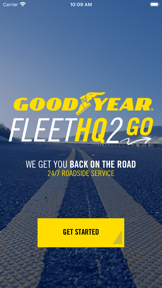
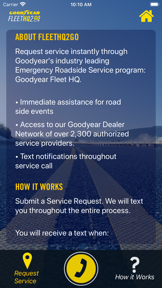

Goodyear FleetHQ2GO is a business utility app for fleet managers to request emergency roadside tire service.
The App DNA
What makes this app unique?
Users hire the app to minimize vehicle downtime during roadside events by accessing Goodyear's proprietary dealer network.
For Fleet managers and commercial truck drivers requiring immediate roadside tire service and maintenance support.
What does it look like?
Key features
Direct in-app request for roadside assistance through the Fleet HQ program
Provides location data and access to over 2,300 authorized service providers
Automated text notifications provided throughout the duration of a service call
How much does it cost?
The app functions as a free utility tool to support the broader Goodyear commercial tire and service business model.
Velocity
Dormant developmentopaqueShow more...
The app has not received a public update in over 19 months, placing it firmly in the zombie category. The last recorded activity consisted of minor platform support updates released in October 2024. There is no evidence of ongoing development, feature expansion, or live operations. The lack of activity suggests the application is no longer being actively maintained.
Who built it?
The Goodyear Tire & Rubber Company
3 apps tracked · Business
 Goodyear NOW
 Goodyear Tire Optix
User Sentiment
What do users think recently?
Review voice lately leans upset.
How are ratings & reviews evolving?
What users say, by theme
- Corporate social responsibility stances trigger negative user sentiment regarding brand alignment and values
2 of 2 recent reviews analyzed · limited sample
Read the full review analysisUnlock 1 more frustration theme, each backed by review evidence.
Access the full report for freeCompetition
Competitive landscape for Goodyear FleetHQ2GO
How's the Business market?
The app functions as a niche B2B utility with minimal public review volume, signaling low consumer engagement outside of mandatory fleet service events.
Read the market outlookThe rivals identified

By Wahana Makmur Sejati
Wahana Honda competes by dominating the vehicle service lifecycle, moving beyond emergency roadside assistance into proactive maintenance and rewards.
- Integrated rewards program incentivizes long-term brand loyalty unlike Goodyear's purely transactional emergency-focused model.
- Comprehensive service booking and order tracking features provide a superior end-to-end digital maintenance experience.



Unlock the head-to-head verdict: where this rival wins, and where it loses.
Access the full report for freeThe Analyst's Read
Key takeaways for Goodyear FleetHQ2GO
Where is it heading?
The fleet management market is shifting toward proactive, data-driven maintenance, leaving Goodyear's reactive roadside model increasingly exposed. Without integrating predictive tools, the app risks becoming a secondary utility that fleet managers bypass for more comprehensive digital maintenance platforms.
- Restrictive tire size inputs prevent users from completing service requests, which directly erodes the app's primary utility value.
- Recent updates focused on operating system compatibility, signaling a maintenance-mode posture rather than active feature expansion.
The SWOT
- 2,300-dealer network provides high-reliability recovery for heavy-duty commercial fleets
- Integrate proactive maintenance scheduling to transition from an emergency utility to a daily fleet management tool
Next best moves
Rebuild tire selection menu to allow custom specifications because current rigidity prevents service requests → increase conversion rate
The counter-intuitive read
The app's low review count is a strategic advantage…
Read the full takeFeature gaps
Proactive maintenance scheduling (available in Wahana Honda but absent here) +2
Since the last report: The app's competitive position has declined due to critical functional failures in the service request flow and negative user sentiment regarding brand values.
Bottom line
Goodyear FleetHQ2GO provides a vital emergency service for fleet operators, but its rigid input constraints and low Android engagement signal a need for immediate functional expansion, so the PM should prioritize custom tire input to prevent user drop-off.
Unlock 2 critical frictions, 1 market threat and the analyst’s take.
Access the full report for freeReport last updated