


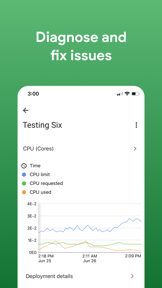

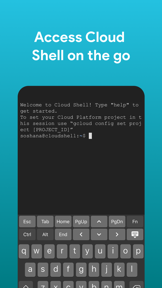

Google Cloud is a productivity app for managing cloud infrastructure services on Android and iOS.
The App DNA
What makes this app unique?
Engineers hire this app to perform emergency incident response and resource monitoring while away from a workstation, so they can maintain uptime without carrying a laptop.
For Cloud engineers, DevOps professionals, and IT administrators managing Google Cloud infrastructure.
What does it look like?
Key features
Provides a browser-based command-line interface to execute gcloud operations directly from mobile devices
Enables direct secure shell access to virtual machine instances from the mobile app
Allows users to build personalized views of Google Cloud service status and metrics
How much does it cost?
The app functions as a free management utility to support the broader Google Cloud consumption-based revenue model.
Velocity
Intense developmentopaqueperformanceShow more...
The app maintains an intense release cadence of approximately 1.25 releases per week based on the observed data. Despite this high frequency, all recent updates are labeled with generic 'bug fixes and performance improvements' copy, indicating a strategy of hiding feature rollouts or utilizing server-side configuration. The development trend is stable and high-volume, prioritizing continuous deployment over traditional versioned feature releases. No specific feature-based milestones are visible in the current release history.
Who built it?
13+ apps tracked · Productivity
 Google Family Link
 Google Earth
 YouTube Kids
 Google TV: Watch Movies & TV
 Google Docs
 Photomath
 Gboard – the Google Keyboard
 Google One
 Google Keep - Notes and lists
 Google News
 Snapseed: Photo Editor
 Google NotebookLM
User Sentiment
What do users think recently?
The recent review mood reads mixed. Users appreciate reliable data storage and retrieval capabilities provide peace of mind for long-term digital asset management, but report persistent session timeouts and disconnection issues prevent effective use of the terminal and cloud shell.
How are ratings & reviews evolving?
What users say, by theme
- Reliable data storage and retrieval capabilities provide peace of mind for long-term digital asset management
- Persistent session timeouts and disconnection issues prevent effective use of the terminal and cloud shell
100 of 149 recent reviews analyzed · high confidence · Mixed overall
Read the full review analysisUnlock 1 user request, each backed by review evidence.
Access the full report for freeCompetition
Competitive landscape for Google Cloud
How's the Productivity market?
Google Cloud maintains a stable presence in the productivity category, though its 4.15 rating on Android contrasts with a lower 3.38 on iOS. The discrepancy in platform stability suggests the Android build better serves the core DevOps user base.
Read the market outlookThe rivals identified

By AMAZON.COM
The definitive benchmark for cloud infrastructure management, consistently setting the standard for mobile-first resource administration.
- Deep-link integration for S3, EC2, and RDS management
- Biometric authentication (FaceID/TouchID) for secure, rapid access
- Granular push notifications for AWS Health events and billing alerts


Unlock the head-to-head verdict: where this rival wins, and where it loses.
Access the full report for freeThe Analyst's Read
Key takeaways for Google Cloud
Where is it heading?
The cloud management market is shifting toward mobile-first actionability, where users expect to perform complex resource configuration rather than just monitoring. Google Cloud remains in maintenance mode, leaving it exposed to competitors like AWS that provide deeper resource-level control.
- Persistent session timeouts in the terminal environment erode user trust, which directly increases churn among critical DevOps power users.
- Integration with Google Workspace identity provides a unique friction-free login experience that competitors cannot replicate without similar enterprise-wide access.
The SWOT
- System-level integration with Google Workspace identity
- Unified billing dashboard correlating spend with licensing
- Education partnerships for B2B distribution
- Agentic AI integration for automated incident remediation
Next best moves
Rebuild terminal session persistence because session timeouts are the #1 complaint → reduce churn among power users.
+ 1 more prioritized moveThe counter-intuitive read
The app's terminal instability is a hidden moat…
Read the full takeFeature gaps
Granular resource-level configuration (available in AWS Console but missing here) +1
Since the last report: The app shows a rating recovery and a shift toward a freemium model, though it remains in a maintenance phase with persistent terminal stability issues.
Bottom line
Google Cloud holds its user base through deep Workspace integration, but terminal instability drives power users to third-party SSH clients, so revenue growth hinges on fixing session persistence to keep DevOps teams within the native console.
Unlock 3 critical frictions, 2 market threats, 1 more prioritized move and the analyst’s take.
Access the full report for freeReport last updated