

Google Fit: Activity Tracker
By Google
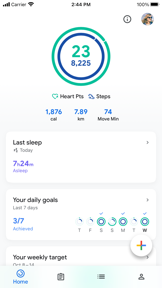


Google Fit is a health and fitness tracking app for iOS and Android that aggregates activity data from sensors and third-party services.
The App DNA
What makes this app unique?
Users hire the app to maintain a unified journal of physical activity and health metrics, reducing the fragmentation caused by using multiple fitness services.
For Individuals seeking to track physical activity and health metrics, particularly those who use multiple fitness apps and want a unified data view.
What does it look like?
Key features
Activity goal system developed with the American Heart Association and World Health Organization to track moderate and intense physical activity.
Aggregates health and fitness data from external services like Strava, MyFitnessPal, and Headspace into a single journal.
Allows users to input activities not captured by sensors, such as Aerobics or Zumba, to maintain a complete record.
How much does it cost?
The app operates as a free, ad-free utility to support the broader Google health data ecosystem.
Velocity
Maintenance developmentperformanceUX improvementsopaqueShow more...
Google Fit maintains a consistent release cadence of approximately 0.19 releases per week, averaging one update every 40 days. The development trend is stable, focusing exclusively on performance, bug fixes, and minor UI adjustments. There is no evidence of new feature development or live-ops activity in the observed data. The publisher utilizes opaque release notes, suggesting that any functional changes are either minor or delivered via server-side updates rather than App Store builds.
Who built it?
13+ apps tracked · Health & Fitness
 Google Family Link
 Google Earth
 YouTube Kids
 Google TV: Watch Movies & TV
 Google Docs
 Photomath
 Gboard – the Google Keyboard
 Google One
 Google Keep - Notes and lists
 Google News
 Snapseed: Photo Editor
 Google NotebookLM
User Sentiment
What do users think recently?
Review voice lately leans upset. Users appreciate the core tracking concept provides motivation for users to maintain their daily activity goals, but report inaccurate step and heart point counting causes significant frustration during daily activity tracking sessions.
How are ratings & reviews evolving?
What users say, by theme
- The core tracking concept provides motivation for users to maintain their daily activity goals
- Inaccurate step and heart point counting causes significant frustration during daily activity tracking sessions
52 of 52 recent reviews analyzed · high confidence · Upset overall
Read the full review analysisUnlock 1 more frustration theme and 1 user request, each backed by review evidence.
Access the full report for freeCompetition
Competitive landscape for Google Fit: Activity Tracker
How's the Health & Fitness market?
Google Fit maintains a consistent presence as a free health utility, though its 4.26 rating on 2,135 ratings suggests a growing gap between user expectations for data accuracy and current performance.
Read the market outlookThe rivals identified

By ModSik
Both apps target health-conscious users seeking to log biometric data, with Blood Sugar & Pressure Tracker directly addressing the specific health metric requests for glucose and blood pressure tracking that Google Fit users currently lack.
- Blood Sugar & Pressure Tracker provides dedicated logging for glucose and blood pressure, which Google Fit lacks.
- Blood Sugar & Pressure Tracker includes specific tagging for meal-time context, whereas Google Fit relies on manual activity logs.

Unlock the head-to-head verdict: where this rival wins, and where it loses.
Access the full report for freeThe Analyst's Read
Key takeaways for Google Fit: Activity Tracker
Where is it heading?
The health-tracking market is consolidating around apps that provide either high-precision recovery data or sticky social engagement. Google Fit remains in maintenance mode, and without stabilizing its core data engine, it will continue to lose users to competitors that offer more reliable tracking and community-driven retention loops.
- Data integrity regressions in the latest release cause step counts to roll back, which directly triggers user abandonment.
- Syncing failures with native health platforms force users to perform manual entry, which erodes the app's core utility.
The SWOT
- Medical partnership with AHA and WHO sustains user trust in Heart Points goal system
- Centralized journal creates high switching costs for users aggregating multi-app fitness data
- Integration of advanced metrics like blood pressure could capture the health-conscious power-user segment
- Granular sleep stage reporting would align the app with modern fitness tracker standards
Next best moves
Audit core tracking engine because step-count rollbacks are the top complaint → stabilize daily active habit
+ 1 more prioritized moveThe counter-intuitive read
The app's lack of social features is not…
Read the full takeFeature gaps
Social community challenges (available in Pacer Pedometer but missing here) +1
Since the last report: Google Fit has transitioned to a maintenance-only lifecycle, with declining user sentiment driven by unresolved data synchronization and step-counting errors.
Bottom line
Google Fit provides a valuable centralized health dashboard, but severe data integrity issues in the latest release erode user trust, so the team must prioritize tracking engine stability over new metric integrations to prevent further churn.
Unlock 2 critical frictions, 2 market threats, 1 more prioritized move and the analyst’s take.
Access the full report for freeReport last updated