






Grocery is a productivity app for iOS that manages shopping lists and pantry inventory via Apple Reminders integration.
The App DNA
What makes this app unique?
Users hire Grocery to reduce the cognitive load of recurring grocery shopping through automated sorting and hands-free Apple Watch interaction.
For Apple ecosystem users who manage household grocery shopping and meal planning, specifically those seeking to reduce time spent in-store.
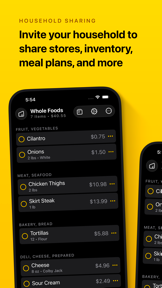
What does it look like?
Key features
Learns shopping patterns from historical check-off data to organize lists by aisle.
Monitors pantry items and expiration dates to manage household stock levels.
Integrates directly with Apple Reminders for system-level list access.
How much does it cost?
Freemium model gates advanced household management behind a subscription while maintaining core list utility for free.
Velocity
Dormant developmentUX improvementsnew contentShow more...
The app has not received a release in over 9 months, placing it firmly in the zombie category. The most recent update provided significant feature additions, but the lack of subsequent activity indicates a cessation of active development. There is no evidence of ongoing maintenance or live operations support.
Who built it?
Conrad Stoll
2 apps tracked · Productivity
 Snowman - Word Guessing Game
User Sentiment
What do users think recently?
How are ratings & reviews evolving?
Not enough recent reviews to extract reliable themes yet.
Read the full review analysisCompetition
Competitive landscape for Grocery - Smart Shopping List
How's the Productivity market?
Grocery maintains a 4.51 rating across 4,690 reviews, positioning it as a stable productivity utility within the Apple ecosystem. The reliance on native Reminders sync differentiates it from standalone apps, though it lacks the broad reach of cross-platform competitors.
Read the market outlookThe rivals identified

By Diego de Paz Sierra
List ◎ directly competes for the same productivity-focused user base by offering a streamlined, list-centric experience that mirrors Grocery's core utility.
- Offers robust list reuse functionality which simplifies recurring shopping trips for power users.
- Provides native iCloud sync capabilities that ensure seamless data consistency across multiple Apple devices.
 BeeTrackContender
 Amazing Marvin - On the GoContender
 Qomon - Campaign, VolunteerContender
 ClaritistContender
Unlock the head-to-head verdict: where this rival wins, and where it loses.
Access the full report for freeThe Analyst's Read
Key takeaways for Grocery - Smart Shopping List
Where is it heading?
The productivity market is consolidating around cross-platform utility, which leaves Grocery's Apple-only posture exposed to broader family-management apps. The app must bridge the gap between simple list management and shared household coordination to maintain its relevance against multi-platform rivals.
- The app maintains a stable rating, indicating that the core list utility continues to meet user expectations for Apple-centric shoppers.
- The lack of cross-platform support creates a churn risk as households increasingly adopt mixed-device environments, limiting long-term growth potential.
The SWOT
- System-level Reminders integration provides high-frequency utility
- Apple Watch integration enables frictionless in-store list management
- Explicit task delegation features could capture household management segments
Next best moves
Ship explicit task delegation features because FamCal captures this segment → increase household retention
+ 1 more prioritized moveThe counter-intuitive read
The reliance on Apple Reminders is not a…
Read the full takeFeature gaps
Robust list reuse functionality (available in List ◎) +1
Since the last report: The report reflects a strategic pivot toward household task delegation and list-reuse features, moving away from the previous focus on stability regressions.
Bottom line
Grocery holds its category lead through sticky Apple-native integration but bleeds power users to more robust list-reuse competitors, so revenue growth hinges on tightening shared household features.
Unlock 2 critical frictions, 2 market threats, 1 more prioritized move and the analyst’s take.
Access the full report for freeReport last updated